Advertisements
Advertisements
प्रश्न
State Kepler’s law which is represented by the relation r3 ∝ T2.
Advertisements
उत्तर
Kepler’s law of periods states that: The cube of the mean distance of a planet from the sun is directly proportional to the square of the time it takes to move around the sun.
APPEARS IN
संबंधित प्रश्न
Three uniform spheres each having a mass M and radius a are kept in such a way that each touches the other two. Find the magnitude of the gravitational force on any of the spheres due to the other two.
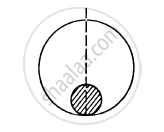
A solid sphere of mass m and radius r is placed inside a hollow thin spherical shell of mass M and radius R as shown in the following figure . A particle of mass m' is placed on the line joining the two centres at a distance x from the point of contact of the sphere and the shell. Find the magnitude of the resultant gravitational force on this particle due to the sphere and the shell if (a) r < x < 2r, (b) 2r < x < 2R and (c) x > 2R.
The law of gravitation gives the gravitational force between :
How will the force of gravitation between two objects change if the distance between them is:
Made four times
A ball is thrown up with a speed of 4.9 ms-1.
Calculate the maximum height it would gain before it begins to fall.
What does a force do in the following case?
You apply brakes to a running car.
Does the force of the earth's gravitation affect the motion of the moon? Explain your answer with reasons.
Law of gravitation gives the gravitational force between
Particles of masses 2M, m and M are respectively at points A, B and C with AB = ½ (BC). m is much-much smaller than M and at time t = 0, they are all at rest (Figure). At subsequent times before any collision takes place ______.

If three equal masses m are placed at the three vertices of an equilateral triangle of side 1/m then what force acts on a particle of mass 2m placed at the centroid?
