Advertisements
Advertisements
प्रश्न
Three uniform spheres each having a mass M and radius a are kept in such a way that each touches the other two. Find the magnitude of the gravitational force on any of the spheres due to the other two.
Advertisements
उत्तर
Three spheres are placed with their centres at A, B and C as shown in the figure.
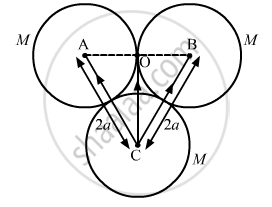
Gravitational force on sphere C due to sphere B is given by
\[\overrightarrow {F}_{CB} = \frac{G m^2}{4 a^2}\cos 60^\circ \hat i + \frac{G m^2}{4 a^2} \cdot \sin 60^\circ \hat j\]
Gravitational force on sphere C due to sphere A is given by \[\overrightarrow {F}_{CA} = - \frac{G m^2}{4 a^2} \cos 60^\circ\hat i + \frac{G m^2}{4 a^2} \cdot \sin 60^\circ\hat j\]
\[\therefore {\overrightarrow F}_{CB} = \overrightarrow {F}_{CB} + \overrightarrow {F}_{CA} \]
\[ = + \frac{2G m^2}{4 a^2}\sin 60^\circ \hat j \]
\[ = + \frac{2G m^2}{4 a^2} \times \frac{\sqrt{3}}{2}\]
i.e., magnitude \[= \frac{\sqrt{3} G m^2}{4 a^2}\] along CO
APPEARS IN
संबंधित प्रश्न
Write the answer of the question with reference to laws of gravitation.
State the universal law of gravitation.
What happens to the force between two objects, if the mass of one object is doubled?
Choose the correct alternative:
Acceleration due to gravity increases/decreases with increasing depth. (assume the earth to be a sphere of uniform density).
Choose the correct answer from among the given ones:
For the problem 8.10, the direction of the gravitational intensity at an arbitrary point P is indicated by the arrow (i) d, (ii) e, (iii) f, (iv) g.
State Kepler’s law which is represented by the relation r3 ∝ T2.
Inside a uniform spherical shell
(a) the gravitational potential is zero
(b) the gravitational field is zero
(c) the gravitational potential is same everywhere
(d) the gravitational field is same everywhere
Three equal masses m are placed at the three corners of an equilateral triangle of side a. Find the force exerted by this system on another particle of mass m placed at (a) the mid-point of a side, (b) at the centre of the triangle.
A semicircular wire has a length L and mass M. A particle of mass m is placed at the centre of the circle. Find the gravitational attraction on the particle due to the wire.
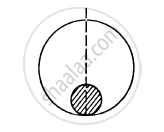
A solid sphere of mass m and radius r is placed inside a hollow thin spherical shell of mass M and radius R as shown in the following figure . A particle of mass m' is placed on the line joining the two centres at a distance x from the point of contact of the sphere and the shell. Find the magnitude of the resultant gravitational force on this particle due to the sphere and the shell if (a) r < x < 2r, (b) 2r < x < 2R and (c) x > 2R.
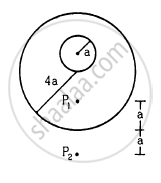
A uniform metal sphere of radius a and mass M is surrounded by a thin uniform spherical shell of equal mass and radius 4a (In the following figure). The centre of the shell falls on the surface of the inner sphere. Find the gravitational field at the points P1 and P2 shown in the figure.
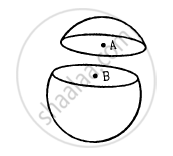
A thin spherical shell having uniform density is cut in two parts by a plane and kept separated as shown in the following figure. The point A is the centre of the plane section of the first part and B is the centre of the plane section of the second part. Show that the gravitational field at A due to the first part is equal in magnitude to the gravitational field at B due to the second part.
Write an expression for the gravitational force of attraction between two bodies of masses m1 and m2 separated by a distance r.
Is the law of gravitation applicable in case of the sun and the moon?
What does a force do in the following case?
You twist a piece of rubber.
State the law of gravitation. Why is it called universal?
Is there a gravitational attraction between you and the book? Explain.
State Newton’s universal law of gravitation. Express it with the mathematical form of force of gravitation?
Three uniform spheres, each having mass m and radius r, are kept in such a way that each touches the other two. The magnitude of the gravitational force on any sphere due to the other two is
The acceleration of the Moon towards the Earth is approximately ______.
