Advertisements
Advertisements
प्रश्न
Suppose the gravitational potential due to a small system is k/r2 at a distance r from it. What will be the gravitational field? Can you think of any such system? What happens if there were negative masses?
Advertisements
उत्तर
The gravitational potential due to the system is given as \[V = \frac{k}{r^2}\]
Gravitational field due to the system :
\[E = - \frac{dV}{dr}\]
\[ \Rightarrow E = - \frac{d}{dr}\left( \frac{k}{r^2} \right) = - \left( - \frac{2k}{r^3} \right)\]
\[ \Rightarrow E = \frac{2k}{r^3}\]
We can see that for this system , \[E \propto \frac{1}{r^3}\]
This type of system is not possible because \[F_g\] is always proportional to inverse of square of distance(experimental fact).
If there were negative masses, then this type of system is possible.
This system is a dipole of two masses, i.e., two masses, one positive and the other negative, separated by a small distance.
In this case, the gradational field due to the dipole is proportional to \[\frac{1}{r^3}\]
APPEARS IN
संबंधित प्रश्न
What happens to the force between two objects, if the mass of one object is doubled?
Answer the following:
An astronaut inside a small space ship orbiting around the earth cannot detect gravity. If the space station orbiting around the earth has a large size, can he hope to detect gravity?
A rocket is fired from the earth towards the sun. At what distance from the earth’s centre is the gravitational force on the rocket zero? Mass of the sun = 2 ×1030 kg, mass of the earth = 6 × 1024 kg. Neglect the effect of other planets etc. (orbital radius = 1.5 × 10¹¹ m).
At noon, the sun and the earth pull the objects on the earth's surface in opposite directions. At midnight, the sun and the earth pull these objects in same direction. Is the weight of an object, as measured by a spring balance on the earth's surface, more at midnight as compared to its weight at noon?
Let V and E be the gravitational potential and gravitational field at a distance r from the centre of a uniform spherical shell. Consider the following two statements :
(A) The plot of V against r is discontinuous.
(B) The plot of E against r is discontinuous.
Consider a planet moving in an elliptical orbit round the sun. The work done on the planet by the gravitational force of the sun
(a) is zero in any small part of the orbit
(b) is zero in some parts of the orbit
(c) is zero in one complete revolution
(d) is zero in no part of the motion.
Who stated the law of gravitation?
How will the force of gravitation between two objects change if the distance between them is:
Infinite
How will the force of gravitation between two objects change if the distance between them is:
Almost zero
The force of attraction between any two material objects is called __________.
What does a force do in the following case?
You twist a piece of rubber.
Name and state the action and reaction in the following case:
Hammering a nail.
What is the difference between gravity and gravitation?
The gravitational force between two bodies is directly proportional to the product of the masses of those bodies and is ______ of the distance between them.
Law of gravitation gives the gravitational force between
Three uniform spheres, each having mass m and radius r, are kept in such a way that each touches the other two. The magnitude of the gravitational force on any sphere due to the other two is
Different points in earth are at slightly different distances from the sun and hence experience different forces due to gravitation. For a rigid body, we know that if various forces act at various points in it, the resultant motion is as if a net force acts on the c.m. (centre of mass) causing translation and a net torque at the c.m. causing rotation around an axis through the c.m. For the earth-sun system (approximating the earth as a uniform density sphere).
Molecules in air in the atmosphere are attracted by gravitational force of the earth. Explain why all of them do not fall into the earth just like an apple falling from a tree.
Six point masses of mass m each are at the vertices of a regular hexagon of side l. Calculate the force on any of the masses.
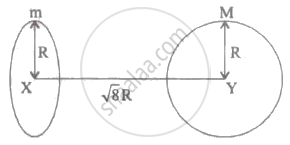
Find the gravitational force of attraction between the ring and sphere as shown in the diagram, where the plane of the ring is perpendicular to the line joining the centres. If `sqrt8` R is the distance between the centres of a ring (of mass 'm')and a sphere (mass 'M') where both have equal radius 'R'.