Advertisements
Advertisements
प्रश्न
Answer the following question.
What are the dimensions of the universal gravitational constant?
Advertisements
उत्तर
The dimensions of universal gravitational constant are: [L3M-1T-2].
APPEARS IN
संबंधित प्रश्न
What happens to the force between two objects, if the masses of both objects are doubled?
Calculate the force of gravitation between the earth and the Sun, given that the mass of the earth = 6 × 1024 kg and of the Sun = 2 × 1030 kg. The average distance between the two is 1.5 × 10¹¹ m.
State the universal law of gravitation. Name the scientist who gave this law.
At noon, the sun and the earth pull the objects on the earth's surface in opposite directions. At midnight, the sun and the earth pull these objects in same direction. Is the weight of an object, as measured by a spring balance on the earth's surface, more at midnight as compared to its weight at noon?
Let V and E represent the gravitational potential and field at a distance r from the centre of a uniform solid sphere. Consider the two statements:
(A) the plot of V against r is discontinuous.
(B) The plot of E against r is discontinuous.
A person sitting in a chair in a satellite feels weightless because
Three uniform spheres each having a mass M and radius a are kept in such a way that each touches the other two. Find the magnitude of the gravitational force on any of the spheres due to the other two.
A tunnel is dug along a diameter of the earth. Find the force on a particle of mass m placed in the tunnel at a distance x from the centre.
A uniform metal sphere of radius a and mass M is surrounded by a thin uniform spherical shell of equal mass and radius 4a (In the following figure). The centre of the shell falls on the surface of the inner sphere. Find the gravitational field at the points P1 and P2 shown in the figure.
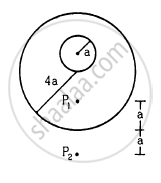
Multiple Choice Question. Select the correct option.
The mass of earth is 6 × 1024 kg and radius of earth is 6.4 × 10⁶ m. The magnitude of force between the mass of 1 kg and the earth is:
How will the force of gravitation between two objects change if the distance between them is:
Made four times
What does a force do in the following case?
You pull the skin of your arm
What does a force do in the following case?
You catch a kicked ball.
You can change the direction in which an object is moving by___________.
Name and state the action and reaction in the following case:
A person walking on the ground.
Two equal and opposite forces acting at the same point on a stationary body. Will the body move? Give reason to explain your answer.
What do you mean by a gravitational constant?
State Newton’s universal law of gravitation. Express it with the mathematical form of force of gravitation?
Give the applications of universal law gravitation.
For the weight of body of mass 5 kg to be zero on equator of the earth, angular velocity of the earth must be (The radius of earth = 6400 km, acceleration due to gravity = 10 m/s2).
Law of gravitation gives the gravitational force between
Three uniform spheres, each having mass m and radius r, are kept in such a way that each touches the other two. The magnitude of the gravitational force on any sphere due to the other two is
Different points in earth are at slightly different distances from the sun and hence experience different forces due to gravitation. For a rigid body, we know that if various forces act at various points in it, the resultant motion is as if a net force acts on the c.m. (centre of mass) causing translation and a net torque at the c.m. causing rotation around an axis through the c.m. For the earth-sun system (approximating the earth as a uniform density sphere).
Molecules in air in the atmosphere are attracted by gravitational force of the earth. Explain why all of them do not fall into the earth just like an apple falling from a tree.
If three equal masses m are placed at the three vertices of an equilateral triangle of side 1/m then what force acts on a particle of mass 2m placed at the centroid?
If the mass of one object is doubled and distance remains the same, the gravitational force will ______.
If the distance between two objects is doubled, the gravitational force becomes ______.
Who measured the value of the Universal Gravitational Constant G using the Cavendish balance?
