Advertisements
Advertisements
प्रश्न
Which of the Kepler’s laws of planetary motion led Newton to establish the inverse-square rule for gravitational force between two bodies ?
Advertisements
उत्तर
The third law of Kepler’s planetary motion (i.e. The law of harmonies) led Newton to establish the inverse – square rule for gravitational force between two bodies.
APPEARS IN
संबंधित प्रश्न
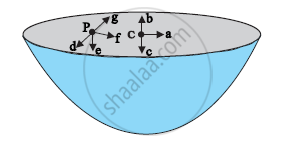
The gravitational intensity at the centre of a hemispherical shell of uniform mass density has the direction indicated by the arrow (see Fig 8.12) (i) a, (ii) b, (iii) c, (iv) 0.
State whether the gravitational force between two masses is attractive or repulsive ?
How will the force of gravitation between two objects change if the distance between them is:
Infinite
Where will you weigh more: at the moon's surface or at the earth's surface?
Explain why:
The atmosphere does not escape.
Is there a gravitational attraction between you and the book? Explain.
The value of universal gravitational constant (G) in the SI unit is ______.
If the distance between two objects is doubled, the gravitational force becomes ______.
A hollow spherical shell of uniform density exerts what gravitational force on a point mass placed inside it?
Newton formulated the Universal Law of Gravitation by combining the ideas of which two scientists with his own Laws of Motion?
