Advertisements
Advertisements
प्रश्न
Four particles having masses m, 2m, 3m and 4m are placed at the four corners of a square of edge a. Find the gravitational force acting on a particle of mass m placed at the centre.
Advertisements
उत्तर
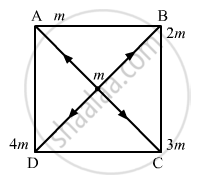
\[\text { Force due to the particle at A }, \overrightarrow{F}_{OA} = \frac{G \times m \times m}{{OA}^2}\]
\[\text { Let OA } = r\]
\[ \therefore \overrightarrow{F}_{OA} = \frac{G \times m \times m}{r^2} \]
\[\text { Here }, r = \sqrt{\left( \frac{a}{2} \right)^2 + \left( \frac{a}{2} \right)^2} = \frac{a}{\sqrt{2}}\]
\[\text { Force due to the particle at B }, \overrightarrow{F}_{OB} = \frac{G \times m \times 2m}{r^2}\]
\[\text { Force due to the particle at C }, \overrightarrow{F}_{OC} = \frac{G \times m \times 3m}{r^2}\]
\[\text { Force due to the particle at D }, \overrightarrow{F}_{OD} = \frac{G \times m \times 4m}{r^2}\]
\[\text { Now, resultant force }= \overrightarrow{F}_{OA} + \overrightarrow{F}_{OB} + \overrightarrow{F}_{OC} + \overrightarrow{F}_{OD} \]
\[ = \frac{2Gmm}{a^2}\left[ - \frac{\overrightarrow{i}}{\sqrt{2}} + \frac{\overrightarrow{j}}{\sqrt{2}} \right] + \frac{4Gmm}{a^2}\left[ \frac{\overrightarrow{i}}{\sqrt{2}} + \frac{\overrightarrow{j}}{\sqrt{2}} \right]\]
\[ = \frac{6Gmm}{a^2}\left[ \frac{\overrightarrow{i}}{\sqrt{2}} - \frac{\vec{j}}{\sqrt{2}} \right] + \frac{8Gmm}{a^2}\left[ \frac{- \overrightarrow{i}}{\sqrt{2}} - \frac{- \overrightarrow{j}}{\sqrt{2}} \right]\]
\[ \therefore F = \frac{4\sqrt{4}G m^2}{a^2} \stackrel\frown {j}\]
APPEARS IN
संबंधित प्रश्न
What is the magnitude of the gravitational force between the earth and a 1 kg object on its surface? (Mass of the earth is 6 × 1024 kg and radius of the earth is 6.4 × 10⁶ m).
The earth and the moon are attracted to each other by gravitational force. Does the earth attract the moon with a force that is greater or smaller or the same as the force with which the moon attracts the earth? Why?
Choose the correct alternative:
Acceleration due to gravity increases/decreases with increasing depth. (assume the earth to be a sphere of uniform density).
Can you think of two particles which do not exert gravitational force on each other?
Suppose the gravitational potential due to a small system is k/r2 at a distance r from it. What will be the gravitational field? Can you think of any such system? What happens if there were negative masses?
Let V and E be the gravitational potential and gravitational field at a distance r from the centre of a uniform spherical shell. Consider the following two statements :
(A) The plot of V against r is discontinuous.
(B) The plot of E against r is discontinuous.
Four particles of equal masses M move along a circle of radius R under the action of their mutual gravitational attraction. Find the speed of each particle.
Two concentric spherical shells have masses M1, M2 and radii R1, R2 (R1 < R2). What is the force exerted by this system on a particle of mass m1 if it is placed at a distance (R1+ R2)/2 from the centre?
A ball is thrown vertically upwards. It goes to a height 20 m and then returns to the ground. Taking acceleration due to gravity g to be 10 ms-2, find: the initial velocity of the ball.
How will the force of gravitation between two objects change if the distance between them is:
Halved
Why don't you feel the force of attraction between your friend sitting close to you and yourself?
A ball is thrown up with a speed of 4.9 ms-1.
Calculate the maximum height it would gain before it begins to fall.
Name and state the action and reaction in the following case:
A person walking on the ground.
Why does a ball moving on a table top eventually stops?
State the law of gravitation. Why is it called universal?
Solve the following problem.
Find the gravitational force between the Sun and the Earth.
Given Mass of the Sun = 1.99 × 1030 kg
Mass of the Earth = 5.98 × 1024 kg
The average distance between the Earth and the Sun = 1.5 × 10¹¹ m.
Give scientific reasons for the following:
Newton's gravitational law is the universal law of gravitation.
Write the answer of the question with reference to laws of gravitation.
Write the value of the universal gravitational constant.
If three equal masses m are placed at the three vertices of an equilateral triangle of side 1/m then what force acts on a particle of mass 2m placed at the centroid?
The acceleration of the Moon towards the Earth is approximately ______.
