Advertisements
Advertisements
प्रश्न
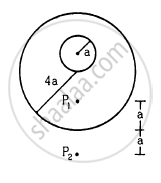
A uniform metal sphere of radius a and mass M is surrounded by a thin uniform spherical shell of equal mass and radius 4a (In the following figure). The centre of the shell falls on the surface of the inner sphere. Find the gravitational field at the points P1 and P2 shown in the figure.
Advertisements
उत्तर
At point P1, the gravitational field due to the sphere and the shell is given by
F \[= \frac{GM}{\left( 3a + a \right)^2} + 0 = \frac{GM}{16 a^2}\]
At point P2, the gravitational field due to the sphere and the shell is given by
\[F = \frac{GM}{\left( a + 4a + a \right)^2} + \frac{GM}{\left( 4a + a \right)^2}\]
\[ \Rightarrow F = \frac{GM}{36 a^2} + \frac{GM}{25 a^2}\]
\[ \Rightarrow F = \frac{GM}{a^2}\left( \frac{1}{36} + \frac{1}{25} \right)\]
\[ \Rightarrow F = \frac{GM}{a^2}\left( \frac{25 + 36}{900} \right)\]
\[ \Rightarrow F = \left( \frac{61}{900} \right)\frac{GM}{a^2}\]
APPEARS IN
संबंधित प्रश्न
Write the answer of the question with reference to laws of gravitation.
State the universal law of gravitation.
State Kepler’s law which is represented by the relation r3 ∝ T2.
Can you think of two particles which do not exert gravitational force on each other?
Consider a planet moving in an elliptical orbit round the sun. The work done on the planet by the gravitational force of the sun
(a) is zero in any small part of the orbit
(b) is zero in some parts of the orbit
(c) is zero in one complete revolution
(d) is zero in no part of the motion.
A semicircular wire has a length L and mass M. A particle of mass m is placed at the centre of the circle. Find the gravitational attraction on the particle due to the wire.
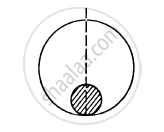
A solid sphere of mass m and radius r is placed inside a hollow thin spherical shell of mass M and radius R as shown in the following figure . A particle of mass m' is placed on the line joining the two centres at a distance x from the point of contact of the sphere and the shell. Find the magnitude of the resultant gravitational force on this particle due to the sphere and the shell if (a) r < x < 2r, (b) 2r < x < 2R and (c) x > 2R.
The gravitational field in a region is given by \[E = \left( 2 \overrightarrow{i} + 3 \overrightarrow{j} \right) N {kg}^{- 1}\] . Show that no work is done by the gravitational field when a particle is moved on the line 3y + 2x = 5.
[Hint : If a line y = mx + c makes angle θ with the X-axis, m = tan θ.]
The law of gravitation gives the gravitational force between :
The force of attraction between any two material objects is called __________.
Is the law of gravitation applicable in case of the sun and the moon?
State the law of gravitation. Why is it called universal?
An apple falls towards the earth due to its gravitational force. The apple also attracts the earth with the same force. Why do we not see the earth rising towards the apple? Explain.
Answer the following question.
State Newton’s law of gravitation and express it in vector form.
To project the rockets which of the following principle(s) is /(are) required?
Choose the wrong option.
Molecules in air in the atmosphere are attracted by gravitational force of the earth. Explain why all of them do not fall into the earth just like an apple falling from a tree.
Newton's universal law of gravitation applies to ______.
If the distance between two objects is doubled, the gravitational force becomes ______.
