Advertisements
Advertisements
प्रश्न
Solve the following problem.
Calculate the acceleration due to gravity at a height of 300 km from the surface of the Earth. (M = 5.98 × 1024 kg, R = 6400 km).
Advertisements
उत्तर
Given: h = 300 km = 0.3 × 10⁶ m, M = 5.98 × 1024 kg, R = 6400 km = 6.4 × 10⁶ m, G = 6.67 × 10⁻¹¹ Nm2/kg2
To find: Acceleration due to gravity at height (gh)
Formula: `"g"_"h" = "GM"/("R + h")^2`
Calculation:
From formula,
`"g"_"h" = (6.67 xx 10^-11 xx 5.98 xx 10^24)/([(6.4 xx 10^6) + (0.3 xx 10^6)]^2)`
`= (6.67 xx 5.98 xx 10^13)/((6.7)^2 xx 10^12)`
= antilog{log(6.67) + log(5.98) - 2log(6.7)} × 10
= antilog{0.8241 + 0.7767 - 2(0.8261)} × 10
= antilog{1.6008 - 1.6522} × 10
= antilog{`bar1`.9486} × 10
= 0.8884 × 10
= 8.884 m/s2
Acceleration due to gravity at 300 km will be 8.884 m/s2.
APPEARS IN
संबंधित प्रश्न
If you compare the gravitational force on the Earth due to the Sun to that due to the Moon, you would find that the Sun’s pull is greater than the Moon’s pull. (You can check this yourself using the data available in the succeeding exercises). However, the tidal effect of the Moon’s pull is greater than the tidal effect of Sun. Why?
Choose the correct alternative:
Acceleration due to gravity is independent of mass of the earth/mass of the body.
Choose the correct answer from among the given ones:
For the problem 8.10, the direction of the gravitational intensity at an arbitrary point P is indicated by the arrow (i) d, (ii) e, (iii) f, (iv) g.
Which of the Kepler’s laws of planetary motion led Newton to establish the inverse-square rule for gravitational force between two bodies ?
Can two particles be in equilibrium under the action of their mutual gravitational force? Can three particles be? Can one of the three particles be?
A person sitting in a chair in a satellite feels weightless because
Inside a uniform spherical shell
(a) the gravitational potential is zero
(b) the gravitational field is zero
(c) the gravitational potential is same everywhere
(d) the gravitational field is same everywhere
A tunnel is dug along a chord of the earth at a perpendicular distance R/2 from the earth's centre. The wall of the tunnel may be assumed to be frictionless. Find the force exerted by the wall on a particle of mass m when it is at a distance x from the centre of the tunnel.
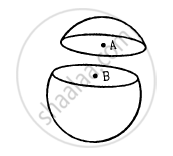
A thin spherical shell having uniform density is cut in two parts by a plane and kept separated as shown in the following figure. The point A is the centre of the plane section of the first part and B is the centre of the plane section of the second part. Show that the gravitational field at A due to the first part is equal in magnitude to the gravitational field at B due to the second part.
Write an expression for the gravitational force of attraction between two bodies of masses m1 and m2 separated by a distance r.
The acceleration produced by a force in an object is directly proportional to the applied _________ And inversely proportional to the _________ Of the object.
How will the force of gravitation between two objects change if the distance between them is:
Doubled
How will the force of gravitation between two objects change if the distance between them is:
Almost zero
Why don't you feel the force of attraction between your friend sitting close to you and yourself?
A ball is thrown up with a speed of 4.9 ms-1.
Calculate the time it takes to reach this height.
What does a force do in the following case?
You twist a piece of rubber.
Name and state the action and reaction in the following case:
A book lying on a table.
State the law of gravitation. Why is it called universal?
State Newton's law of gravitation. What is the difference between:
Gravity and gravitation
The distance-time values for an object moving along straight line are given below:
| Time (s) | Distance (m) |
| 0 | 0 |
| 1 | 1 |
| 2 | 8 |
| 3 | 27 |
Answer the following question.
What are the dimensions of the universal gravitational constant?
The gravitational force between two bodies is directly proportional to the product of the masses of those bodies and is ______ of the distance between them.
To project the rockets which of the following principle(s) is /(are) required?
The force of gravitation between two bodies of mass 1 kg each separated by a distance of 1 m in vacuum is ____________.
Particles of masses 2M, m and M are respectively at points A, B and C with AB = ½ (BC). m is much-much smaller than M and at time t = 0, they are all at rest (Figure). At subsequent times before any collision takes place ______.

The gravitational force between a hollow spherical shell (of radius R and uniform density) and a point mass is F. Show the nature of F vs r graph where r is the distance of the point from the centre of the hollow spherical shell of uniform density.
Shown are several curves (Figure). Explain with reason, which ones amongst them can be possible trajectories traced by a projectile (neglect air friction).
A hollow spherical shell of uniform density exerts what gravitational force on a point mass placed inside it?
