Advertisements
Advertisements
Question
Solve the following problem.
Calculate the acceleration due to gravity at a height of 300 km from the surface of the Earth. (M = 5.98 × 1024 kg, R = 6400 km).
Advertisements
Solution
Given: h = 300 km = 0.3 × 10⁶ m, M = 5.98 × 1024 kg, R = 6400 km = 6.4 × 10⁶ m, G = 6.67 × 10⁻¹¹ Nm2/kg2
To find: Acceleration due to gravity at height (gh)
Formula: `"g"_"h" = "GM"/("R + h")^2`
Calculation:
From formula,
`"g"_"h" = (6.67 xx 10^-11 xx 5.98 xx 10^24)/([(6.4 xx 10^6) + (0.3 xx 10^6)]^2)`
`= (6.67 xx 5.98 xx 10^13)/((6.7)^2 xx 10^12)`
= antilog{log(6.67) + log(5.98) - 2log(6.7)} × 10
= antilog{0.8241 + 0.7767 - 2(0.8261)} × 10
= antilog{1.6008 - 1.6522} × 10
= antilog{`bar1`.9486} × 10
= 0.8884 × 10
= 8.884 m/s2
Acceleration due to gravity at 300 km will be 8.884 m/s2.
APPEARS IN
RELATED QUESTIONS
What happens to the force between two objects, if the distance between the objects is doubled and tripled?
Calculate the force of gravitation between the earth and the Sun, given that the mass of the earth = 6 × 1024 kg and of the Sun = 2 × 1030 kg. The average distance between the two is 1.5 × 10¹¹ m.
Answer the following:
You can shield a charge from electrical forces by putting it inside a hollow conductor. Can you shield a body from the gravitational influence of nearby matter by putting it inside a hollow sphere or by some other means?
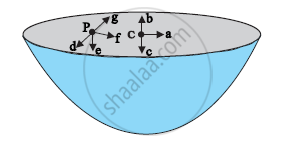
The gravitational intensity at the centre of a hemispherical shell of uniform mass density has the direction indicated by the arrow (see Fig 8.12) (i) a, (ii) b, (iii) c, (iv) 0.
How will you ‘weigh the sun’, that is estimate its mass? The mean orbital radius of the earth around the sun is 1.5 × 10⁸ km.
Universal law of gravitation states that every object exerts a gravitational force of attraction on every other object. If this is true, why don’t we notice such forces ? Why don’t the two objects in a room move towards each other due to this force ?
Can you think of two particles which do not exert gravitational force on each other?
Let V and E be the gravitational potential and gravitational field at a distance r from the centre of a uniform spherical shell. Consider the following two statements :
(A) The plot of V against r is discontinuous.
(B) The plot of E against r is discontinuous.
A body is suspended from a spring balance kept in a satellite. The reading of the balance is W1 when the satellite goes in an orbit of radius R and is W2 when it goes in an orbit of radius 2 −R.
Which of the following quantities remain constant in a planetary motion (consider elliptical orbits) as seen from the sun?
A solid sphere of mass m and radius r is placed inside a hollow thin spherical shell of mass M and radius R as shown in the following figure . A particle of mass m' is placed on the line joining the two centres at a distance x from the point of contact of the sphere and the shell. Find the magnitude of the resultant gravitational force on this particle due to the sphere and the shell if (a) r < x < 2r, (b) 2r < x < 2R and (c) x > 2R.
A ball is thrown vertically upwards. It goes to a height 20 m and then returns to the ground. Taking acceleration due to gravity g to be 10 ms-2, find: the initial velocity of the ball.
The acceleration produced by a force in an object is directly proportional to the applied _________ And inversely proportional to the _________ Of the object.
How will the force of gravitation between two objects change if the distance between them is:
Doubled
How will the force of gravitation between two objects change if the distance between them is:
Infinite
The force of attraction between any two material objects is called __________.
A ball is thrown up with a speed of 4.9 ms-1.
Prove that the time of ascent is equal to the time of descent.
At what height above the earth's surface would the value of acceleration due to gravity be half of what it is on the surface? Take the radius of earth to be R.
Name and state the action and reaction in the following case:
A book lying on a table.
Explain the difference between g and G.
State Newton's law of gravitation. What is the difference between:
g and G?
The gravitational force between two bodies is directly proportional to the product of the masses of those bodies and is ______ of the distance between them.
To project the rockets which of the following principle(s) is /(are) required?
For the weight of body of mass 5 kg to be zero on equator of the earth, angular velocity of the earth must be (The radius of earth = 6400 km, acceleration due to gravity = 10 m/s2).
Particles of masses 2M, m and M are respectively at points A, B and C with AB = ½ (BC). m is much-much smaller than M and at time t = 0, they are all at rest (Figure). At subsequent times before any collision takes place ______.

The gravitational force between a hollow spherical shell (of radius R and uniform density) and a point mass is F. Show the nature of F vs r graph where r is the distance of the point from the centre of the hollow spherical shell of uniform density.
Write the answer of the question with reference to laws of gravitation.
Write the value of the universal gravitational constant.
The Superposition Principle states that the net gravitational force on an object is ______.
