Advertisements
Advertisements
Question
Write the three laws given by Kepler. How did they help Newton to arrive at the inverse square law of gravity?
Advertisements
Solution
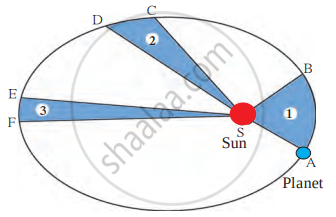
The orbit of a planet moving around the sun
Kepler’s first law: The orbit of a planet is an ellipse with the Sun at one of the foci.
In the above figure, the elliptical orbit of a planet revolving around the sun. The position of the Sun is indicated by S.
Kepler’s second law: The line joining the planet and the sun sweeps equal areas in equal intervals of time.
A → B, C → D and E → F are the displacements of the planet in equal intervals of time.
The straight lines AS and CS sweep equal areas in equal intervals of time, i.e., area ASB and CSD are equal.
Kepler’s third law: The square of its period of revolution around the Sun is directly proportional to the cube of the mean distance of a planet from the Sun.
Thus, if r is the average distance of the planet from the Sun and T is its period of revolution, then
T2 α r3 i.e., `(T^2)/(r^3)` = constant = K
For simplicity, we shall assume the orbit to be a circle.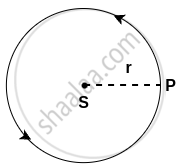
Circular motion of planet around the sun
S denotes the position of the Sun, P denotes the position of a planet at a given instant, and r denotes the radius of the orbit (= the distance of the planet from the Sun). Here, the speed of the planet is uniform.
v = `"distance travelled"/"time taken"`
= `(2pir)/T`
If m is the mass of the planet, the centripetal force exerted on the planet by the Sun (= gravitational force),
F = `(mv^2)/r`
F = `(m ((2pir)/T)^2)/r`
F = `(4 m pi^2r)/T^2`
Multiplying and dividing by r2 we get,
F = `(4 m pi^2)/r^2`
F = `(r^3/T^2)` ...(i)
According to Kepler’s third law,
`T^2/r^3 = K` ...(ii) [∵ K = constant]
Substituting (ii) in (i)
F = `(4m pi^2)/(K) xx 1/r^2`
F = constant × `1/r^2` [∵ where, `(4 m pi^2)/K` = constant]
∴ `F prop 1/r^2`
APPEARS IN
RELATED QUESTIONS
Write the formula to find the magnitude of the gravitational force between the earth and an object on the surface of the earth.
What happens to the force between two objects, if the distance between the objects is doubled and tripled?
State the universal law of gravitation. Name the scientist who gave this law.
Suppose the gravitational potential due to a small system is k/r2 at a distance r from it. What will be the gravitational field? Can you think of any such system? What happens if there were negative masses?
The weight of an object is more at the poles than at the equator. Is it beneficial to purchase goods at equator and sell them at the pole? Does it matter whether a spring balance is used or an equal-beam balance is used?
A person brings a mass of 1 kg from infinity to a point A. Initially the mass was at rest but it moves at a speed of 2 m s −1 as it reaches A. The work done by the person on the mass is −3 J. The potential at A is
Four particles of equal masses M move along a circle of radius R under the action of their mutual gravitational attraction. Find the speed of each particle.
A semicircular wire has a length L and mass M. A particle of mass m is placed at the centre of the circle. Find the gravitational attraction on the particle due to the wire.
Derive an expression for the gravitational field due to a uniform rod of length L and mass M at a point on its perpendicular bisector at a distance d from the centre.
A ball is thrown vertically upwards. It goes to a height 20 m and then returns to the ground. Taking acceleration due to gravity g to be 10 ms-2 , find :
the total time of journey of the ball .
The acceleration produced by a force in an object is directly proportional to the applied _________ And inversely proportional to the _________ Of the object.
How will the force of gravitation between two objects change if the distance between them is:
Infinite
A ball is thrown up with a speed of 4.9 ms-1.
Calculate the maximum height it would gain before it begins to fall.
What does a force do in the following case?
You apply brakes to a running car.
You can change the direction in which an object is moving by___________.
What is the difference between gravity and gravitation?
Choose the wrong option.
Six point masses of mass m each are at the vertices of a regular hexagon of side l. Calculate the force on any of the masses.
Complete the chart below.
| F(N) | M1(kg) | M2(kg) | D(m) |
| (a) | 50 | 84 | 02 |
| 16 × 109 | 1.63 × 10²² | (b) | 34 |
Four identical particles of equal masses 1 kg made to move along the circumference of a circle of radius 1 m under the action of their own mutual gravitational attraction. The speed of each particle will be ______.
