Advertisements
Advertisements
प्रश्न
Write the three laws given by Kepler. How did they help Newton to arrive at the inverse square law of gravity?
Advertisements
उत्तर
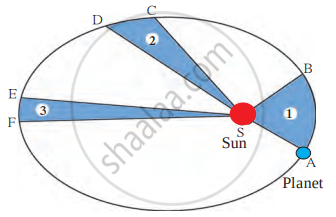
The orbit of a planet moving around the sun
Kepler’s first law: The orbit of a planet is an ellipse with the Sun at one of the foci.
In the above figure, the elliptical orbit of a planet revolving around the sun. The position of the Sun is indicated by S.
Kepler’s second law: The line joining the planet and the sun sweeps equal areas in equal intervals of time.
A → B, C → D and E → F are the displacements of the planet in equal intervals of time.
The straight lines AS and CS sweep equal areas in equal intervals of time, i.e., area ASB and CSD are equal.
Kepler’s third law: The square of its period of revolution around the Sun is directly proportional to the cube of the mean distance of a planet from the Sun.
Thus, if r is the average distance of the planet from the Sun and T is its period of revolution, then
T2 α r3 i.e., `(T^2)/(r^3)` = constant = K
For simplicity, we shall assume the orbit to be a circle.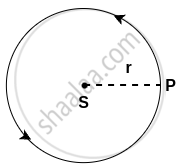
Circular motion of planet around the sun
S denotes the position of the Sun, P denotes the position of a planet at a given instant, and r denotes the radius of the orbit (= the distance of the planet from the Sun). Here, the speed of the planet is uniform.
v = `"distance travelled"/"time taken"`
= `(2pir)/T`
If m is the mass of the planet, the centripetal force exerted on the planet by the Sun (= gravitational force),
F = `(mv^2)/r`
F = `(m ((2pir)/T)^2)/r`
F = `(4 m pi^2r)/T^2`
Multiplying and dividing by r2 we get,
F = `(4 m pi^2)/r^2`
F = `(r^3/T^2)` ...(i)
According to Kepler’s third law,
`T^2/r^3 = K` ...(ii) [∵ K = constant]
Substituting (ii) in (i)
F = `(4m pi^2)/(K) xx 1/r^2`
F = constant × `1/r^2` [∵ where, `(4 m pi^2)/K` = constant]
∴ `F prop 1/r^2`
APPEARS IN
संबंधित प्रश्न
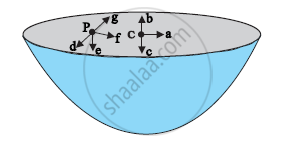
The gravitational intensity at the centre of a hemispherical shell of uniform mass density has the direction indicated by the arrow (see Fig 8.12) (i) a, (ii) b, (iii) c, (iv) 0.
Universal law of gravitation states that every object exerts a gravitational force of attraction on every other object. If this is true, why don’t we notice such forces ? Why don’t the two objects in a room move towards each other due to this force ?
Let V and E be the gravitational potential and gravitational field at a distance r from the centre of a uniform spherical shell. Consider the following two statements :
(A) The plot of V against r is discontinuous.
(B) The plot of E against r is discontinuous.
Three equal masses m are placed at the three corners of an equilateral triangle of side a. Find the force exerted by this system on another particle of mass m placed at (a) the mid-point of a side, (b) at the centre of the triangle.
A tunnel is dug along a diameter of the earth. Find the force on a particle of mass m placed in the tunnel at a distance x from the centre.
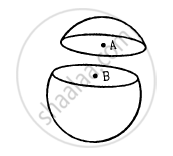
A thin spherical shell having uniform density is cut in two parts by a plane and kept separated as shown in the following figure. The point A is the centre of the plane section of the first part and B is the centre of the plane section of the second part. Show that the gravitational field at A due to the first part is equal in magnitude to the gravitational field at B due to the second part.
A ball is thrown vertically upwards. It goes to a height 20 m and then returns to the ground. Taking acceleration due to gravity g to be 10 ms-2, find: the initial velocity of the ball.
Multiple Choice Question. Select the correct option.
The mass of earth is 6 × 1024 kg and radius of earth is 6.4 × 10⁶ m. The magnitude of force between the mass of 1 kg and the earth is:
Who stated the law of gravitation?
How will the force of gravitation between two objects change if the distance between them is:
Almost zero
Is the law of gravitation applicable in case of the sun and the moon?
What is meant by the equation :
`g= Gxxm/r^2`
where the symbols have their usual meanings.
Gravity is another kind of ________. It exerts all through the ________. The Sun's gravity keeps the ___________ in their orbits. Gravity can only be felt with very large ________.
Explain the difference between g and G.
The value of universal gravitational constant (G) in the SI unit is ______.
State the universal law of gravitation and derive its mathematical expression.
Law of gravitation gives the gravitational force between
Particles of masses 2M, m and M are respectively at points A, B and C with AB = ½ (BC). m is much-much smaller than M and at time t = 0, they are all at rest (Figure). At subsequent times before any collision takes place ______.

Give scientific reasons for the following:
Newton's gravitational law is the universal law of gravitation.
If the mass of one object is doubled and distance remains the same, the gravitational force will ______.
