Advertisements
Advertisements
प्रश्न
Write the three laws given by Kepler. How did they help Newton to arrive at the inverse square law of gravity?
Advertisements
उत्तर
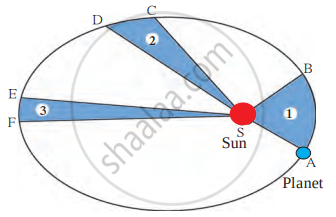
The orbit of a planet moving around the sun
Kepler’s first law: The orbit of a planet is an ellipse with the Sun at one of the foci.
In the above figure, the elliptical orbit of a planet revolving around the sun. The position of the Sun is indicated by S.
Kepler’s second law: The line joining the planet and the sun sweeps equal areas in equal intervals of time.
A → B, C → D and E → F are the displacements of the planet in equal intervals of time.
The straight lines AS and CS sweep equal areas in equal intervals of time, i.e., area ASB and CSD are equal.
Kepler’s third law: The square of its period of revolution around the Sun is directly proportional to the cube of the mean distance of a planet from the Sun.
Thus, if r is the average distance of the planet from the Sun and T is its period of revolution, then
T2 α r3 i.e., `(T^2)/(r^3)` = constant = K
For simplicity, we shall assume the orbit to be a circle.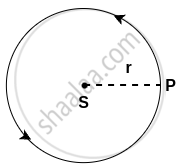
Circular motion of planet around the sun
S denotes the position of the Sun, P denotes the position of a planet at a given instant, and r denotes the radius of the orbit (= the distance of the planet from the Sun). Here, the speed of the planet is uniform.
v = `"distance travelled"/"time taken"`
= `(2pir)/T`
If m is the mass of the planet, the centripetal force exerted on the planet by the Sun (= gravitational force),
F = `(mv^2)/r`
F = `(m ((2pir)/T)^2)/r`
F = `(4 m pi^2r)/T^2`
Multiplying and dividing by r2 we get,
F = `(4 m pi^2)/r^2`
F = `(r^3/T^2)` ...(i)
According to Kepler’s third law,
`T^2/r^3 = K` ...(ii) [∵ K = constant]
Substituting (ii) in (i)
F = `(4m pi^2)/(K) xx 1/r^2`
F = constant × `1/r^2` [∵ where, `(4 m pi^2)/K` = constant]
∴ `F prop 1/r^2`
APPEARS IN
संबंधित प्रश्न
If the moon attracts the earth, why does the earth not move towards the moon?
What happens to the force between two objects, if the distance between the objects is doubled and tripled?
What is the importance of the universal law of gravitation?
Choose the correct alternative:
Acceleration due to gravity is independent of mass of the earth/mass of the body.
At noon, the sun and the earth pull the objects on the earth's surface in opposite directions. At midnight, the sun and the earth pull these objects in same direction. Is the weight of an object, as measured by a spring balance on the earth's surface, more at midnight as compared to its weight at noon?
A person sitting in a chair in a satellite feels weightless because
Inside a uniform spherical shell
(a) the gravitational potential is zero
(b) the gravitational field is zero
(c) the gravitational potential is same everywhere
(d) the gravitational field is same everywhere
Three uniform spheres each having a mass M and radius a are kept in such a way that each touches the other two. Find the magnitude of the gravitational force on any of the spheres due to the other two.
State whether the gravitational force between two masses is attractive or repulsive ?
Write an expression for the gravitational force of attraction between two bodies of masses m1 and m2 separated by a distance r.
A ball is thrown up with a speed of 4.9 ms-1.
Prove that the time of ascent is equal to the time of descent.
What does a force do in the following case?
You catch a kicked ball.
Is there a gravitational attraction between you and the book? Explain.
Answer the following question.
What are the dimensions of the universal gravitational constant?
Choose the wrong option.
Shown are several curves (Figure). Explain with reason, which ones amongst them can be possible trajectories traced by a projectile (neglect air friction).
Six point masses of mass m each are at the vertices of a regular hexagon of side l. Calculate the force on any of the masses.
Two particles of equal mass 'm' go around a circle of radius R under the action of their mutual gravitational attraction. The speed of each particle with respect to its centre of mass is ______.
Ocean tides on Earth are mainly caused by ______.
The Superposition Principle states that the net gravitational force on an object is ______.
