Advertisements
Advertisements
प्रश्न
A tunnel is dug along a diameter of the earth. Find the force on a particle of mass m placed in the tunnel at a distance x from the centre.
Advertisements
उत्तर
Mass of the Earth,
\[M = \left( \frac{4}{3} \right)\pi R^3 \rho\] ...(i)
Consider an imaginary sphere of radius x with centre O as shown in the figure below :
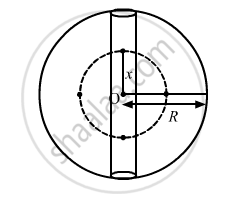
\[\text { Mass of the imaginary sphere }, M' = \left( \frac{4}{3} \right)\pi x^3 \rho . . . (ii)\]
\[\text { From (i) and (ii), we have : }\]
\[\frac{M'}{M} = \frac{x^3}{R^3}\]
∴ Gravitational force on the particle of mass m is given by F \[= \frac{GMm}{x^2}\]
\[\Rightarrow F = \frac{GM x^3 m}{R^3 x^2} = \frac{GMm}{R^3}x\]
APPEARS IN
संबंधित प्रश्न
Choose the correct answer from among the given ones:
For the problem 8.10, the direction of the gravitational intensity at an arbitrary point P is indicated by the arrow (i) d, (ii) e, (iii) f, (iv) g.
Universal law of gravitation states that every object exerts a gravitational force of attraction on every other object. If this is true, why don’t we notice such forces ? Why don’t the two objects in a room move towards each other due to this force ?
Let V and E be the gravitational potential and gravitational field at a distance r from the centre of a uniform spherical shell. Consider the following two statements :
(A) The plot of V against r is discontinuous.
(B) The plot of E against r is discontinuous.
Consider a planet moving in an elliptical orbit round the sun. The work done on the planet by the gravitational force of the sun
(a) is zero in any small part of the orbit
(b) is zero in some parts of the orbit
(c) is zero in one complete revolution
(d) is zero in no part of the motion.
Which of the following quantities remain constant in a planetary motion (consider elliptical orbits) as seen from the sun?
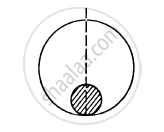
A solid sphere of mass m and radius r is placed inside a hollow thin spherical shell of mass M and radius R as shown in the following figure . A particle of mass m' is placed on the line joining the two centres at a distance x from the point of contact of the sphere and the shell. Find the magnitude of the resultant gravitational force on this particle due to the sphere and the shell if (a) r < x < 2r, (b) 2r < x < 2R and (c) x > 2R.
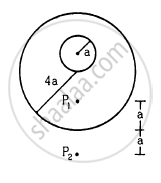
A uniform metal sphere of radius a and mass M is surrounded by a thin uniform spherical shell of equal mass and radius 4a (In the following figure). The centre of the shell falls on the surface of the inner sphere. Find the gravitational field at the points P1 and P2 shown in the figure.
Write an expression for the gravitational force of attraction between two bodies of masses m1 and m2 separated by a distance r.
How will the force of gravitation between two objects change if the distance between them is:
Infinite
Why don't you feel the force of attraction between your friend sitting close to you and yourself?
Why does a ball moving on a table top eventually stops?
Gravity is another kind of ________. It exerts all through the ________. The Sun's gravity keeps the ___________ in their orbits. Gravity can only be felt with very large ________.
Is there a gravitational attraction between you and the book? Explain.
The distance-time values for an object moving along straight line are given below:
| Time (s) | Distance (m) |
| 0 | 0 |
| 1 | 1 |
| 2 | 8 |
| 3 | 27 |
Answer the following question.
What are the dimensions of the universal gravitational constant?
For the weight of body of mass 5 kg to be zero on equator of the earth, angular velocity of the earth must be (The radius of earth = 6400 km, acceleration due to gravity = 10 m/s2).
If the law of gravitation, instead of being inverse-square law, becomes an inverse-cube law- ______.
- planets will not have elliptic orbits.
- circular orbits of planets is not possible.
- projectile motion of a stone thrown by hand on the surface of the earth will be approximately parabolic.
- there will be no gravitational force inside a spherical shell of uniform density.
Shown are several curves (Figure). Explain with reason, which ones amongst them can be possible trajectories traced by a projectile (neglect air friction).
A hollow spherical shell of uniform density exerts what gravitational force on a point mass placed inside it?
