Advertisements
Advertisements
प्रश्न
Derive an expression for the gravitational field due to a uniform rod of length L and mass M at a point on its perpendicular bisector at a distance d from the centre.
Advertisements
उत्तर
Consider a small mass element of length dx at a distance x from the centre of the rod.
Mass of the mass element, dm = (M/L) × dx
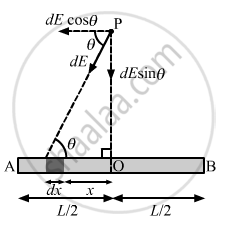
Gravitational field due to this element at point P is given by \[dE = \frac{G\left( dm \right) \times 1}{\left( d^2 + x^2 \right)}\]
The components of the gravitational field due to the symmetrical mass element along the length of the rod cancel each other.
Now, resultant gravitational field = 2dE sin θ
\[= 2 \times \frac{G\left( dm \right)}{\left( d^2 + x^2 \right)} \times \frac{d}{\sqrt{\left( d^2 + x^2 \right)}}\]
\[ = \frac{2 \times GM \times d dx}{L\left( d^2 + x^2 \right) \left\{ \left( \sqrt{d^2 + x^2} \right) \right\}}\]
Total gravitational field due to the rod at point P is given by \[E = \int_0^{L/2} \frac{2Gmd \ dx}{L \left( d^2 + x^2 \right)^{3/2}}\]
APPEARS IN
संबंधित प्रश्न
Choose the correct alternative:
Acceleration due to gravity increases/decreases with increasing depth. (assume the earth to be a sphere of uniform density).
Which of the Kepler’s laws of planetary motion led Newton to establish the inverse-square rule for gravitational force between two bodies ?
State two applications of universal law of gravitation.
At noon, the sun and the earth pull the objects on the earth's surface in opposite directions. At midnight, the sun and the earth pull these objects in same direction. Is the weight of an object, as measured by a spring balance on the earth's surface, more at midnight as compared to its weight at noon?
A particle of mass 100 g is kept on the surface of a uniform sphere of mass 10 kg and radius 10 cm. Find the work to be done against the gravitational force between them to take the particle away from the sphere.
The law of gravitation gives the gravitational force between :
How will the force of gravitation between two objects change if the distance between them is:
Made four times
What is meant by the equation :
`g= Gxxm/r^2`
where the symbols have their usual meanings.
What does a force do in the following case?
You twist a piece of rubber.
What is the difference between gravity and gravitation?
An apple falls towards the earth due to its gravitational force. The apple also attracts the earth with the same force. Why do we not see the earth rising towards the apple? Explain.
The distance-time values for an object moving along straight line are given below:
| Time (s) | Distance (m) |
| 0 | 0 |
| 1 | 1 |
| 2 | 8 |
| 3 | 27 |
The value of universal gravitational constant (G) in the SI unit is ______.
To project the rockets which of the following principle(s) is /(are) required?
Choose the wrong option.
The gravitational force between a hollow spherical shell (of radius R and uniform density) and a point mass is F. Show the nature of F vs r graph where r is the distance of the point from the centre of the hollow spherical shell of uniform density.
Two particles of equal mass 'm' go around a circle of radius R under the action of their mutual gravitational attraction. The speed of each particle with respect to its centre of mass is ______.
If three equal masses m are placed at the three vertices of an equilateral triangle of side 1/m then what force acts on a particle of mass 2m placed at the centroid?
Observe the figure and answer the questions:

- State Newton's universal law of gravitation.
- If the distance between the two bodies is tripled, how will the gravitational force between them change?
- What will happen to gravitational force, if mass of one of the object is doubled?
If the distance between two objects is doubled, the gravitational force becomes ______.
