Advertisements
Advertisements
प्रश्न
A semicircular wire has a length L and mass M. A particle of mass m is placed at the centre of the circle. Find the gravitational attraction on the particle due to the wire.
Advertisements
उत्तर
Consider a small mass element of length dl subtending dθ angle at the centre.

In the semicircle, we can consider a small element dθ.
Then length of the element, dl = R dθ
Mass of the element, dm \[= \left( \frac{M}{L} \right)R d\theta\]
Force on the mass element is given by
\[dF = \frac{Gm}{R^2}dm = \frac{GMRm}{L R^2}{d}{\theta}\]
The symmetric components along AB cancel each other.
Now, net gravitational force on the particle at O is given by
\[F = \int2dF\sin \theta\]
\[ = \int\frac{2GMm}{LR}\sin \theta d\theta\]
\[ \therefore F = \int_0^\pi/2 \frac{- 2GMm}{LR}\sin \theta d\theta\]
\[ = \frac{2GMm}{LR} \left[ - \cos \theta \right]_0^\pi/2 \]
\[ = - 2\frac{GMm}{LR}\left( - 1 \right)\]
\[ = \frac{2GMm}{LR} = \frac{2GMm}{LL/\pi}\]
\[ = \frac{2\pi G Mm}{L^2}\]
APPEARS IN
संबंधित प्रश्न
What happens to the force between two objects, if the distance between the objects is doubled and tripled?
Answer the following:
You can shield a charge from electrical forces by putting it inside a hollow conductor. Can you shield a body from the gravitational influence of nearby matter by putting it inside a hollow sphere or by some other means?
Choose the correct alternative:
Acceleration due to gravity increases/decreases with increasing depth. (assume the earth to be a sphere of uniform density).
Which of the Kepler’s laws of planetary motion led Newton to establish the inverse-square rule for gravitational force between two bodies ?
Can we apply Newton’s third law to the gravitational force ? Explain your answer.
State and explain Kepler's laws of planetary motion. Draw diagrams to illustrate these laws.
At noon, the sun and the earth pull the objects on the earth's surface in opposite directions. At midnight, the sun and the earth pull these objects in same direction. Is the weight of an object, as measured by a spring balance on the earth's surface, more at midnight as compared to its weight at noon?
Two concentric spherical shells have masses M1, M2 and radii R1, R2 (R1 < R2). What is the force exerted by this system on a particle of mass m1 if it is placed at a distance (R1+ R2)/2 from the centre?
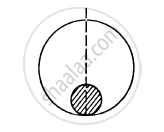
A solid sphere of mass m and radius r is placed inside a hollow thin spherical shell of mass M and radius R as shown in the following figure . A particle of mass m' is placed on the line joining the two centres at a distance x from the point of contact of the sphere and the shell. Find the magnitude of the resultant gravitational force on this particle due to the sphere and the shell if (a) r < x < 2r, (b) 2r < x < 2R and (c) x > 2R.
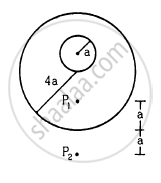
A uniform metal sphere of radius a and mass M is surrounded by a thin uniform spherical shell of equal mass and radius 4a (In the following figure). The centre of the shell falls on the surface of the inner sphere. Find the gravitational field at the points P1 and P2 shown in the figure.
The acceleration produced by a force in an object is directly proportional to the applied _________ And inversely proportional to the _________ Of the object.
How will the force of gravitation between two objects change if the distance between them is:
Halved
How will the force of gravitation between two objects change if the distance between them is:
Made four times
The force of attraction between any two material objects is called __________.
A ball is thrown up with a speed of 4.9 ms-1.
Calculate the maximum height it would gain before it begins to fall.
What is the difference between gravity and gravitation?
Explain the difference between g and G.
Shown are several curves (Figure). Explain with reason, which ones amongst them can be possible trajectories traced by a projectile (neglect air friction).
Observe the figure and answer the questions:

- State Newton's universal law of gravitation.
- If the distance between the two bodies is tripled, how will the gravitational force between them change?
- What will happen to gravitational force, if mass of one of the object is doubled?
Who measured the value of the Universal Gravitational Constant G using the Cavendish balance?
