Advertisements
Advertisements
Question
A semicircular wire has a length L and mass M. A particle of mass m is placed at the centre of the circle. Find the gravitational attraction on the particle due to the wire.
Advertisements
Solution
Consider a small mass element of length dl subtending dθ angle at the centre.

In the semicircle, we can consider a small element dθ.
Then length of the element, dl = R dθ
Mass of the element, dm \[= \left( \frac{M}{L} \right)R d\theta\]
Force on the mass element is given by
\[dF = \frac{Gm}{R^2}dm = \frac{GMRm}{L R^2}{d}{\theta}\]
The symmetric components along AB cancel each other.
Now, net gravitational force on the particle at O is given by
\[F = \int2dF\sin \theta\]
\[ = \int\frac{2GMm}{LR}\sin \theta d\theta\]
\[ \therefore F = \int_0^\pi/2 \frac{- 2GMm}{LR}\sin \theta d\theta\]
\[ = \frac{2GMm}{LR} \left[ - \cos \theta \right]_0^\pi/2 \]
\[ = - 2\frac{GMm}{LR}\left( - 1 \right)\]
\[ = \frac{2GMm}{LR} = \frac{2GMm}{LL/\pi}\]
\[ = \frac{2\pi G Mm}{L^2}\]
APPEARS IN
RELATED QUESTIONS
How does the force of gravitation between two objects change when the distance between them is reduced to half?
What happens to the force between two objects, if the masses of both objects are doubled?
How will you ‘weigh the sun’, that is estimate its mass? The mean orbital radius of the earth around the sun is 1.5 × 10⁸ km.
The weight of an object is more at the poles than at the equator. Is it beneficial to purchase goods at equator and sell them at the pole? Does it matter whether a spring balance is used or an equal-beam balance is used?
Three uniform spheres each having a mass M and radius a are kept in such a way that each touches the other two. Find the magnitude of the gravitational force on any of the spheres due to the other two.
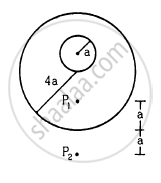
A uniform metal sphere of radius a and mass M is surrounded by a thin uniform spherical shell of equal mass and radius 4a (In the following figure). The centre of the shell falls on the surface of the inner sphere. Find the gravitational field at the points P1 and P2 shown in the figure.
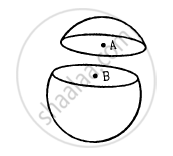
A thin spherical shell having uniform density is cut in two parts by a plane and kept separated as shown in the following figure. The point A is the centre of the plane section of the first part and B is the centre of the plane section of the second part. Show that the gravitational field at A due to the first part is equal in magnitude to the gravitational field at B due to the second part.
The mass of moon is about 0.012 times that of earth and its diameter is about 0.25 times that of earth. The value of G on the moon will be:
Distinguish between gravity and gravitation
How will the force of gravitation between two objects change if the distance between them is:
Made four times
The force of attraction between any two material objects is called __________.
State the law of gravitation. Why is it called universal?
Is there a gravitational attraction between you and the book? Explain.
State Newton's law of gravitation. What is the difference between:
g and G?
Give the applications of universal law gravitation.
As observed from earth, the sun appears to move in an approximate circular orbit. For the motion of another planet like mercury as observed from earth, this would ______.
The gravitational force between a hollow spherical shell (of radius R and uniform density) and a point mass is F. Show the nature of F vs r graph where r is the distance of the point from the centre of the hollow spherical shell of uniform density.
The gravitational force between a hollow spherical shell (of radius R and uniform density) and a point mass is F. Show the nature of F vs r graph where r is the distance of the point from the centre of the hollow spherical shell of uniform density.
Observe the figure and answer the questions:

- State Newton's universal law of gravitation.
- If the distance between the two bodies is tripled, how will the gravitational force between them change?
- What will happen to gravitational force, if mass of one of the object is doubled?
Who measured the value of the Universal Gravitational Constant G using the Cavendish balance?
