Advertisements
Advertisements
Question
Derive an expression for the gravitational field due to a uniform rod of length L and mass M at a point on its perpendicular bisector at a distance d from the centre.
Advertisements
Solution
Consider a small mass element of length dx at a distance x from the centre of the rod.
Mass of the mass element, dm = (M/L) × dx
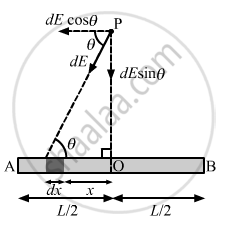
Gravitational field due to this element at point P is given by \[dE = \frac{G\left( dm \right) \times 1}{\left( d^2 + x^2 \right)}\]
The components of the gravitational field due to the symmetrical mass element along the length of the rod cancel each other.
Now, resultant gravitational field = 2dE sin θ
\[= 2 \times \frac{G\left( dm \right)}{\left( d^2 + x^2 \right)} \times \frac{d}{\sqrt{\left( d^2 + x^2 \right)}}\]
\[ = \frac{2 \times GM \times d dx}{L\left( d^2 + x^2 \right) \left\{ \left( \sqrt{d^2 + x^2} \right) \right\}}\]
Total gravitational field due to the rod at point P is given by \[E = \int_0^{L/2} \frac{2Gmd \ dx}{L \left( d^2 + x^2 \right)^{3/2}}\]
APPEARS IN
RELATED QUESTIONS
What is the magnitude of the gravitational force between the earth and a 1 kg object on its surface? (Mass of the earth is 6 × 1024 kg and radius of the earth is 6.4 × 10⁶ m).
What happens to the force between two objects, if the distance between the objects is doubled and tripled?
Calculate the force of gravitation between the earth and the Sun, given that the mass of the earth = 6 × 1024 kg and of the Sun = 2 × 1030 kg. The average distance between the two is 1.5 × 10¹¹ m.
State two applications of universal law of gravitation.
Can you think of two particles which do not exert gravitational force on each other?
A body is suspended from a spring balance kept in a satellite. The reading of the balance is W1 when the satellite goes in an orbit of radius R and is W2 when it goes in an orbit of radius 2 −R.
The law of gravitation gives the gravitational force between :
A ball is thrown vertically upwards. It goes to a height 20 m and then returns to the ground. Taking acceleration due to gravity g to be 10 ms-2 , find :
the final velocity of the ball on reaching the ground .
Define one Newton. How much maximum acceleration can it produce in a mass of 1 kg?
Who stated the law of gravitation?
Name and state the action and reaction in the following case:
A person walking on the ground.
Show that gravity decreases at higher altitudes.
The value of universal gravitational constant (G) in the SI unit is ______.
Mahendra and Virat are sitting at a distance of 1m from each other. Their masses are 75 kg and 80 kg respectively. What is the gravitational force between them? (G = 6.67 × 10⁻¹¹ Nm2/kg2)
If the law of gravitation, instead of being inverse-square law, becomes an inverse-cube law- ______.
- planets will not have elliptic orbits.
- circular orbits of planets is not possible.
- projectile motion of a stone thrown by hand on the surface of the earth will be approximately parabolic.
- there will be no gravitational force inside a spherical shell of uniform density.
How is the gravitational force between two point masses affected when they are dipped in water keeping the separation between them the same?
Complete the chart below.
| F(N) | M1(kg) | M2(kg) | D(m) |
| (a) | 50 | 84 | 02 |
| 16 × 109 | 1.63 × 10²² | (b) | 34 |
Ocean tides on Earth are mainly caused by ______.
The gravitational force between two objects acts in which direction?
