Advertisements
Advertisements
Question
Two concentric spherical shells have masses M1, M2 and radii R1, R2 (R1 < R2). What is the force exerted by this system on a particle of mass m1 if it is placed at a distance (R1+ R2)/2 from the centre?
Advertisements
Solution
Consider that mass m is at a distance \[\frac{R_1 + R_2}{2}\] as shown in the figure.
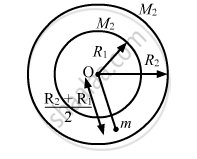
The gravitational force of m due to the shell of M2 is zero, because the mass is inside the shell.
∴ Gravitational force due to the shell of mass M2 = \[\frac{G M_1 m}{\left( \frac{R_1 + R_2}{2} \right)^2} = \frac{4G M_1 m}{\left( R_1 + R_2 \right)^2}\]
APPEARS IN
RELATED QUESTIONS
State Kepler’s law which is represented by the relation r3 ∝ T2.
At noon, the sun and the earth pull the objects on the earth's surface in opposite directions. At midnight, the sun and the earth pull these objects in same direction. Is the weight of an object, as measured by a spring balance on the earth's surface, more at midnight as compared to its weight at noon?
A body is suspended from a spring balance kept in a satellite. The reading of the balance is W1 when the satellite goes in an orbit of radius R and is W2 when it goes in an orbit of radius 2 −R.
Two spherical balls of mass 10 kg each are placed 10 cm apart. Find the gravitational force of attraction between them.
The law of gravitation gives the gravitational force between :
The acceleration produced by a force in an object is directly proportional to the applied _________ And inversely proportional to the _________ Of the object.
All objects in the universe attract each other along the line joining their________.
What is meant by the equation :
`g= Gxxm/r^2`
where the symbols have their usual meanings.
Why does a ball moving on a table top eventually stops?
State Newton's law of gravitation. What is the difference between:
g and G?
Solve the following problem.
Find the gravitational force between the Sun and the Earth.
Given Mass of the Sun = 1.99 × 1030 kg
Mass of the Earth = 5.98 × 1024 kg
The average distance between the Earth and the Sun = 1.5 × 10¹¹ m.
Law of gravitation gives the gravitational force between
The gravitational force between a hollow spherical shell (of radius R and uniform density) and a point mass is F. Show the nature of F vs r graph where r is the distance of the point from the centre of the hollow spherical shell of uniform density.
Four identical particles of equal masses 1 kg made to move along the circumference of a circle of radius 1 m under the action of their own mutual gravitational attraction. The speed of each particle will be ______.
The Superposition Principle states that the net gravitational force on an object is ______.
The acceleration of the Moon towards the Earth is approximately ______.
If the distance between two objects is doubled, the gravitational force becomes ______.
A hollow spherical shell of uniform density exerts what gravitational force on a point mass placed inside it?
For an object outside a uniform solid sphere, from where is the sphere's mass considered to act?
