Advertisements
Advertisements
Question
What do you mean by a gravitational constant?
Advertisements
Solution
- From Newton’s law of gravitation,
F = G`("m"_1"m"_2)/"r"^2`
where, G = constant called universal gravitational constant. Its value is 6.67 × 10⁻¹¹ N m2/kg2. - G = `"Fr"^2/("m"_1"m"_2)`
If m1 = m2 = 1 kg, r = 1 m then F = G.
Hence, the universal gravitational constant is the force of gravitation between two particles of unit mass separated by unit distance.
APPEARS IN
RELATED QUESTIONS
Write the answer of the question with reference to laws of gravitation.
State the universal law of gravitation.
The earth and the moon are attracted to each other by gravitational force. Does the earth attract the moon with a force that is greater or smaller or the same as the force with which the moon attracts the earth? Why?
Calculate the force of gravitation between the earth and the Sun, given that the mass of the earth = 6 × 1024 kg and of the Sun = 2 × 1030 kg. The average distance between the two is 1.5 × 10¹¹ m.
Choose the correct answer from among the given ones:
For the problem 8.10, the direction of the gravitational intensity at an arbitrary point P is indicated by the arrow (i) d, (ii) e, (iii) f, (iv) g.
How will you ‘weigh the sun’, that is estimate its mass? The mean orbital radius of the earth around the sun is 1.5 × 10⁸ km.
Can we apply Newton’s third law to the gravitational force ? Explain your answer.
Inside a uniform spherical shell
(a) the gravitational potential is zero
(b) the gravitational field is zero
(c) the gravitational potential is same everywhere
(d) the gravitational field is same everywhere
Derive an expression for the gravitational field due to a uniform rod of length L and mass M at a point on its perpendicular bisector at a distance d from the centre.
A tunnel is dug along a chord of the earth at a perpendicular distance R/2 from the earth's centre. The wall of the tunnel may be assumed to be frictionless. Find the force exerted by the wall on a particle of mass m when it is at a distance x from the centre of the tunnel.
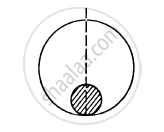
A solid sphere of mass m and radius r is placed inside a hollow thin spherical shell of mass M and radius R as shown in the following figure . A particle of mass m' is placed on the line joining the two centres at a distance x from the point of contact of the sphere and the shell. Find the magnitude of the resultant gravitational force on this particle due to the sphere and the shell if (a) r < x < 2r, (b) 2r < x < 2R and (c) x > 2R.
The acceleration produced by a force in an object is directly proportional to the applied _________ And inversely proportional to the _________ Of the object.
Who stated the law of gravitation?
How will the force of gravitation between two objects change if the distance between them is:
Halved
How will the force of gravitation between two objects change if the distance between them is:
Infinite
You can change the direction in which an object is moving by___________.
Explain the difference between g and G.
Answer the following question.
What are the dimensions of the universal gravitational constant?
The gravitational force between two bodies is directly proportional to the product of the masses of those bodies and is ______ of the distance between them.
The value of universal gravitational constant (G) in the SI unit is ______.
Give the applications of universal law gravitation.
Choose the wrong option.
Molecules in air in the atmosphere are attracted by gravitational force of the earth. Explain why all of them do not fall into the earth just like an apple falling from a tree.
Six point masses of mass m each are at the vertices of a regular hexagon of side l. Calculate the force on any of the masses.
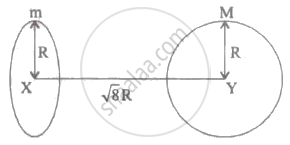
Find the gravitational force of attraction between the ring and sphere as shown in the diagram, where the plane of the ring is perpendicular to the line joining the centres. If `sqrt8` R is the distance between the centres of a ring (of mass 'm')and a sphere (mass 'M') where both have equal radius 'R'.
Newton's universal law of gravitation applies to ______.
Observe the figure and answer the questions:

- State Newton's universal law of gravitation.
- If the distance between the two bodies is tripled, how will the gravitational force between them change?
- What will happen to gravitational force, if mass of one of the object is doubled?
Ocean tides on Earth are mainly caused by ______.
