Advertisements
Advertisements
Question
Three uniform spheres each having a mass M and radius a are kept in such a way that each touches the other two. Find the magnitude of the gravitational force on any of the spheres due to the other two.
Advertisements
Solution
Three spheres are placed with their centres at A, B and C as shown in the figure.
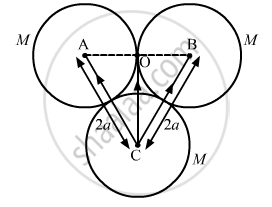
Gravitational force on sphere C due to sphere B is given by
\[\overrightarrow {F}_{CB} = \frac{G m^2}{4 a^2}\cos 60^\circ \hat i + \frac{G m^2}{4 a^2} \cdot \sin 60^\circ \hat j\]
Gravitational force on sphere C due to sphere A is given by \[\overrightarrow {F}_{CA} = - \frac{G m^2}{4 a^2} \cos 60^\circ\hat i + \frac{G m^2}{4 a^2} \cdot \sin 60^\circ\hat j\]
\[\therefore {\overrightarrow F}_{CB} = \overrightarrow {F}_{CB} + \overrightarrow {F}_{CA} \]
\[ = + \frac{2G m^2}{4 a^2}\sin 60^\circ \hat j \]
\[ = + \frac{2G m^2}{4 a^2} \times \frac{\sqrt{3}}{2}\]
i.e., magnitude \[= \frac{\sqrt{3} G m^2}{4 a^2}\] along CO
APPEARS IN
RELATED QUESTIONS
If the moon attracts the earth, why does the earth not move towards the moon?
Answer the following:
You can shield a charge from electrical forces by putting it inside a hollow conductor. Can you shield a body from the gravitational influence of nearby matter by putting it inside a hollow sphere or by some other means?
Choose the correct alternative:
Acceleration due to gravity increases/decreases with increasing depth. (assume the earth to be a sphere of uniform density).
Let V and E be the gravitational potential and gravitational field at a distance r from the centre of a uniform spherical shell. Consider the following two statements :
(A) The plot of V against r is discontinuous.
(B) The plot of E against r is discontinuous.
A body is suspended from a spring balance kept in a satellite. The reading of the balance is W1 when the satellite goes in an orbit of radius R and is W2 when it goes in an orbit of radius 2 −R.
Inside a uniform spherical shell
(a) the gravitational potential is zero
(b) the gravitational field is zero
(c) the gravitational potential is same everywhere
(d) the gravitational field is same everywhere
A tunnel is dug along a chord of the earth at a perpendicular distance R/2 from the earth's centre. The wall of the tunnel may be assumed to be frictionless. Find the force exerted by the wall on a particle of mass m when it is at a distance x from the centre of the tunnel.
How will the force of gravitation between two objects change if the distance between them is:
Halved
How will the force of gravitation between two objects change if the distance between them is:
Almost zero
What is meant by the equation :
`g= Gxxm/r^2`
where the symbols have their usual meanings.
Name and state the action and reaction in the following case:
A person walking on the ground.
The distance-time values for an object moving along straight line are given below:
| Time (s) | Distance (m) |
| 0 | 0 |
| 1 | 1 |
| 2 | 8 |
| 3 | 27 |
Mahendra and Virat are sitting at a distance of 1m from each other. Their masses are 75 kg and 80 kg respectively. What is the gravitational force between them? (G = 6.67 × 10⁻¹¹ Nm2/kg2)
State Newton’s universal law of gravitation. Express it with the mathematical form of force of gravitation?
The force of gravitation between two bodies of mass 1 kg each separated by a distance of 1 m in vacuum is ____________.
Six point masses of mass m each are at the vertices of a regular hexagon of side l. Calculate the force on any of the masses.
The Superposition Principle states that the net gravitational force on an object is ______.
If the distance between two objects is doubled, the gravitational force becomes ______.
Who measured the value of the Universal Gravitational Constant G using the Cavendish balance?
