Advertisements
Advertisements
Question
Suppose the gravitational potential due to a small system is k/r2 at a distance r from it. What will be the gravitational field? Can you think of any such system? What happens if there were negative masses?
Advertisements
Solution
The gravitational potential due to the system is given as \[V = \frac{k}{r^2}\]
Gravitational field due to the system :
\[E = - \frac{dV}{dr}\]
\[ \Rightarrow E = - \frac{d}{dr}\left( \frac{k}{r^2} \right) = - \left( - \frac{2k}{r^3} \right)\]
\[ \Rightarrow E = \frac{2k}{r^3}\]
We can see that for this system , \[E \propto \frac{1}{r^3}\]
This type of system is not possible because \[F_g\] is always proportional to inverse of square of distance(experimental fact).
If there were negative masses, then this type of system is possible.
This system is a dipole of two masses, i.e., two masses, one positive and the other negative, separated by a small distance.
In this case, the gradational field due to the dipole is proportional to \[\frac{1}{r^3}\]
APPEARS IN
RELATED QUESTIONS
What happens to the force between two objects, if the masses of both objects are doubled?
State the universal law of gravitation. Name the scientist who gave this law.
A person sitting in a chair in a satellite feels weightless because
Four particles having masses m, 2m, 3m and 4m are placed at the four corners of a square of edge a. Find the gravitational force acting on a particle of mass m placed at the centre.
Three uniform spheres each having a mass M and radius a are kept in such a way that each touches the other two. Find the magnitude of the gravitational force on any of the spheres due to the other two.
The mass of moon is about 0.012 times that of earth and its diameter is about 0.25 times that of earth. The value of G on the moon will be:
The law of gravitation gives the gravitational force between :
Who stated the law of gravitation?
How will the force of gravitation between two objects change if the distance between them is:
Infinite
What does a force do in the following case?
You twist a piece of rubber.
What does a force do in the following case?
You apply brakes to a running car.
Name and state the action and reaction in the following case:
Hammering a nail.
Two equal and opposite forces acting at the same point on a stationary body. Will the body move? Give reason to explain your answer.
Solve the following problem.
Calculate the acceleration due to gravity at a height of 300 km from the surface of the Earth. (M = 5.98 × 1024 kg, R = 6400 km).
The gravitational force between two bodies is directly proportional to the product of the masses of those bodies and is ______ of the distance between them.
State the universal law of gravitation and derive its mathematical expression.
The gravitational force between a hollow spherical shell (of radius R and uniform density) and a point mass is F. Show the nature of F vs r graph where r is the distance of the point from the centre of the hollow spherical shell of uniform density.
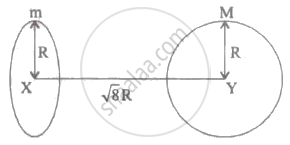
Find the gravitational force of attraction between the ring and sphere as shown in the diagram, where the plane of the ring is perpendicular to the line joining the centres. If `sqrt8` R is the distance between the centres of a ring (of mass 'm')and a sphere (mass 'M') where both have equal radius 'R'.
Observe the figure and answer the questions:

- State Newton's universal law of gravitation.
- If the distance between the two bodies is tripled, how will the gravitational force between them change?
- What will happen to gravitational force, if mass of one of the object is doubled?
The Superposition Principle states that the net gravitational force on an object is ______.
