Advertisements
Advertisements
Question
Consider a planet moving in an elliptical orbit round the sun. The work done on the planet by the gravitational force of the sun
(a) is zero in any small part of the orbit
(b) is zero in some parts of the orbit
(c) is zero in one complete revolution
(d) is zero in no part of the motion.
Advertisements
Solution
(b) is zero in some parts of the orbit
(c) is zero in one complete revolution
When a planet is moving in an elliptical orbit, at some point, the line joining the centre of the Sun and the planet is perpendicular to the velocity of the planet. For that instant, work done by the gravitational force on the planet becomes zero. As there is no net increase in the speed of the planet after one complete revolution about the Sun, the work done by the gravitational force on the planet in one complete revolution is zero.
Note:For elliptical orbits angle between force ans velocity is always 90 so there the work done is zero in any small part of the orbit.
APPEARS IN
RELATED QUESTIONS
The earth and the moon are attracted to each other by gravitational force. Does the earth attract the moon with a force that is greater or smaller or the same as the force with which the moon attracts the earth? Why?
What happens to the force between two objects, if the distance between the objects is doubled and tripled?
What happens to the force between two objects, if the masses of both objects are doubled?
What is the importance of the universal law of gravitation?
Calculate the force of gravitation between the earth and the Sun, given that the mass of the earth = 6 × 1024 kg and of the Sun = 2 × 1030 kg. The average distance between the two is 1.5 × 10¹¹ m.
If you compare the gravitational force on the Earth due to the Sun to that due to the Moon, you would find that the Sun’s pull is greater than the Moon’s pull. (You can check this yourself using the data available in the succeeding exercises). However, the tidal effect of the Moon’s pull is greater than the tidal effect of Sun. Why?
Choose the correct alternative:
Acceleration due to gravity is independent of mass of the earth/mass of the body.
State Kepler’s law which is represented by the relation r3 ∝ T2.
Derive an expression for the gravitational field due to a uniform rod of length L and mass M at a point on its perpendicular bisector at a distance d from the centre.
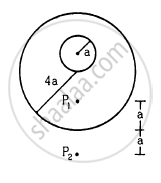
A uniform metal sphere of radius a and mass M is surrounded by a thin uniform spherical shell of equal mass and radius 4a (In the following figure). The centre of the shell falls on the surface of the inner sphere. Find the gravitational field at the points P1 and P2 shown in the figure.
A ball is thrown vertically upwards. It goes to a height 20 m and then returns to the ground. Taking acceleration due to gravity g to be 10 ms-2, find: the initial velocity of the ball.
A ball is thrown up with a speed of 4.9 ms-1.
Calculate the maximum height it would gain before it begins to fall.
A ball is thrown up with a speed of 4.9 ms-1.
Prove that the time of ascent is equal to the time of descent.
State the law of gravitation. Why is it called universal?
The gravitational force between two bodies is directly proportional to the product of the masses of those bodies and is ______ of the distance between them.
For the weight of body of mass 5 kg to be zero on equator of the earth, angular velocity of the earth must be (The radius of earth = 6400 km, acceleration due to gravity = 10 m/s2).
Different points in earth are at slightly different distances from the sun and hence experience different forces due to gravitation. For a rigid body, we know that if various forces act at various points in it, the resultant motion is as if a net force acts on the c.m. (centre of mass) causing translation and a net torque at the c.m. causing rotation around an axis through the c.m. For the earth-sun system (approximating the earth as a uniform density sphere).
The gravitational force between two objects acts in which direction?
