Advertisements
Advertisements
Question
Four particles having masses m, 2m, 3m and 4m are placed at the four corners of a square of edge a. Find the gravitational force acting on a particle of mass m placed at the centre.
Advertisements
Solution
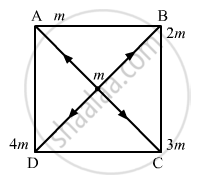
\[\text { Force due to the particle at A }, \overrightarrow{F}_{OA} = \frac{G \times m \times m}{{OA}^2}\]
\[\text { Let OA } = r\]
\[ \therefore \overrightarrow{F}_{OA} = \frac{G \times m \times m}{r^2} \]
\[\text { Here }, r = \sqrt{\left( \frac{a}{2} \right)^2 + \left( \frac{a}{2} \right)^2} = \frac{a}{\sqrt{2}}\]
\[\text { Force due to the particle at B }, \overrightarrow{F}_{OB} = \frac{G \times m \times 2m}{r^2}\]
\[\text { Force due to the particle at C }, \overrightarrow{F}_{OC} = \frac{G \times m \times 3m}{r^2}\]
\[\text { Force due to the particle at D }, \overrightarrow{F}_{OD} = \frac{G \times m \times 4m}{r^2}\]
\[\text { Now, resultant force }= \overrightarrow{F}_{OA} + \overrightarrow{F}_{OB} + \overrightarrow{F}_{OC} + \overrightarrow{F}_{OD} \]
\[ = \frac{2Gmm}{a^2}\left[ - \frac{\overrightarrow{i}}{\sqrt{2}} + \frac{\overrightarrow{j}}{\sqrt{2}} \right] + \frac{4Gmm}{a^2}\left[ \frac{\overrightarrow{i}}{\sqrt{2}} + \frac{\overrightarrow{j}}{\sqrt{2}} \right]\]
\[ = \frac{6Gmm}{a^2}\left[ \frac{\overrightarrow{i}}{\sqrt{2}} - \frac{\vec{j}}{\sqrt{2}} \right] + \frac{8Gmm}{a^2}\left[ \frac{- \overrightarrow{i}}{\sqrt{2}} - \frac{- \overrightarrow{j}}{\sqrt{2}} \right]\]
\[ \therefore F = \frac{4\sqrt{4}G m^2}{a^2} \stackrel\frown {j}\]
APPEARS IN
RELATED QUESTIONS
Answer the following:
You can shield a charge from electrical forces by putting it inside a hollow conductor. Can you shield a body from the gravitational influence of nearby matter by putting it inside a hollow sphere or by some other means?
Choose the correct alternative:
Acceleration due to gravity increases/decreases with increasing altitude.
Which of the Kepler’s laws of planetary motion led Newton to establish the inverse-square rule for gravitational force between two bodies ?
State the universal law of gravitation. Name the scientist who gave this law.
Universal law of gravitation states that every object exerts a gravitational force of attraction on every other object. If this is true, why don’t we notice such forces ? Why don’t the two objects in a room move towards each other due to this force ?
Consider a planet moving in an elliptical orbit round the sun. The work done on the planet by the gravitational force of the sun
(a) is zero in any small part of the orbit
(b) is zero in some parts of the orbit
(c) is zero in one complete revolution
(d) is zero in no part of the motion.
Which of the following quantities remain constant in a planetary motion (consider elliptical orbits) as seen from the sun?
A ball is thrown vertically upwards. It goes to a height 20 m and then returns to the ground. Taking acceleration due to gravity g to be 10 ms-2 , find :
the total time of journey of the ball .
How will the force of gravitation between two objects change if the distance between them is:
Almost zero
Is the law of gravitation applicable in case of the sun and the moon?
Where will you weigh more: at the moon's surface or at the earth's surface?
Explain why:
The atmosphere does not escape.
The ______ force is much weaker than other forces in nature.
For the weight of body of mass 5 kg to be zero on equator of the earth, angular velocity of the earth must be (The radius of earth = 6400 km, acceleration due to gravity = 10 m/s2).
The force of gravitation between two bodies of mass 1 kg each separated by a distance of 1 m in vacuum is ____________.
As observed from earth, the sun appears to move in an approximate circular orbit. For the motion of another planet like mercury as observed from earth, this would ______.
The gravitational force between a hollow spherical shell (of radius R and uniform density) and a point mass is F. Show the nature of F vs r graph where r is the distance of the point from the centre of the hollow spherical shell of uniform density.
Answer the following questions in reference to the figure below:

- Which relation is shown in the figure?
- What will happen if the mass of one of the objects is doubled?
Ocean tides on Earth are mainly caused by ______.
The Superposition Principle states that the net gravitational force on an object is ______.
