Advertisements
Advertisements
Question
Three equal masses m are placed at the three corners of an equilateral triangle of side a. Find the force exerted by this system on another particle of mass m placed at (a) the mid-point of a side, (b) at the centre of the triangle.
Advertisements
Solution
(a) Consider that mass 'm' is placed at the midpoint O of side AB of equilateral triangle ABC.

AO = BO = \[\frac{a}{2}\]
Then \[\overrightarrow{F}_{OA} = \frac{4G m^2}{a^2}\] along OA
Also, \[\overrightarrow{F}_{OB} = \frac{4 G m^2}{a^2}\]along OB
OC = \[\frac{\sqrt{3}a}{2}\]
\[\overrightarrow{F}_{OC} = \frac{4 G m^2}{\left\{ \left( 3 \right) a^2 \right\}} = \frac{4G m^2}{3 a^2}\] along OC
The net force on the particle at O is \[\overrightarrow{F} = \overrightarrow{F}_{OA} + \overrightarrow{F}_{OB} + \overrightarrow{F}_{OC}\]
Since equal and opposite forces cancel each other, we have :
\[\overrightarrow{F} = \overrightarrow{F}_{OC} = \frac{4 G m^2}{\left\{ \left( 3 \right) a^2 \right\}} = \frac{4G m^2}{3 a^2}\] along OC.
(b) If the particle placed at O (centroid)

All the forces are equal in magnitude but their directions are different as shown in the figure.
Equal and opposite forces along OM and ON cancel each other.
i.e., \[F\cos30^\circ= F\cos30^\circ\]
∴ Resultant force \[= F - 2F\sin30 = 0\]
APPEARS IN
RELATED QUESTIONS
How does the force of gravitation between two objects change when the distance between them is reduced to half?
What happens to the force between two objects, if the masses of both objects are doubled?
If you compare the gravitational force on the Earth due to the Sun to that due to the Moon, you would find that the Sun’s pull is greater than the Moon’s pull. (You can check this yourself using the data available in the succeeding exercises). However, the tidal effect of the Moon’s pull is greater than the tidal effect of Sun. Why?
State Kepler’s law which is represented by the relation r3 ∝ T2.
Which of the Kepler’s laws of planetary motion led Newton to establish the inverse-square rule for gravitational force between two bodies ?
Write the three laws given by Kepler. How did they help Newton to arrive at the inverse square law of gravity?
A person sitting in a chair in a satellite feels weightless because
Two spherical balls of mass 10 kg each are placed 10 cm apart. Find the gravitational force of attraction between them.
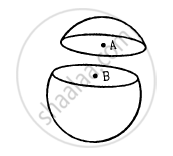
A thin spherical shell having uniform density is cut in two parts by a plane and kept separated as shown in the following figure. The point A is the centre of the plane section of the first part and B is the centre of the plane section of the second part. Show that the gravitational field at A due to the first part is equal in magnitude to the gravitational field at B due to the second part.
Define one Newton. How much maximum acceleration can it produce in a mass of 1 kg?
How will the force of gravitation between two objects change if the distance between them is:
Doubled
All objects in the universe attract each other along the line joining their________.
What does a force do in the following case?
You catch a kicked ball.
Name and state the action and reaction in the following case:
A book lying on a table.
Is there a gravitational attraction between you and the book? Explain.
State the universal law of gravitation and derive its mathematical expression.
Particles of masses 2M, m and M are respectively at points A, B and C with AB = ½ (BC). m is much-much smaller than M and at time t = 0, they are all at rest (Figure). At subsequent times before any collision takes place ______.

We can shield a charge from electric fields by putting it inside a hollow conductor. Can we shield a body from the gravitational influence of nearby matter by putting it inside a hollow sphere or by some other means?
