Advertisements
Advertisements
Question
State the universal law of gravitation and derive its mathematical expression.
Advertisements
Solution
This law states that every particle of matter in this universe attracts every other particle with a force. This force is directly proportional to the product of their masses and inversely proportional to the square of the distance between the centers of these masses. The direction of the force acts along the line joining the masses.
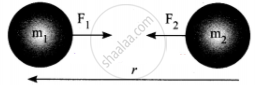
gravitational force between two masses
The force between the masses is always attractive and it does not depend on the medium where they are placed.
Let, m1 and m2 be the masses of two bodies A and B placed r metre apart in space.
Force F ∝ m1 × m2
F ∝ 1/r2
On combining the above two expressions
F ∝ `("m"_1xx"m"_2)/"r"^2`
F = `("Gm"_1"m"_2)/r^2`
Where G is the universal gravitational constant.
Its value in SI unit is 6.674 × 10⁻¹¹ Nm2 kg-2.
APPEARS IN
RELATED QUESTIONS
The earth and the moon are attracted to each other by gravitational force. Does the earth attract the moon with a force that is greater or smaller or the same as the force with which the moon attracts the earth? Why?
What happens to the force between two objects, if the distance between the objects is doubled and tripled?
Choose the correct alternative:
Acceleration due to gravity increases/decreases with increasing altitude.
Consider a planet moving in an elliptical orbit round the sun. The work done on the planet by the gravitational force of the sun
(a) is zero in any small part of the orbit
(b) is zero in some parts of the orbit
(c) is zero in one complete revolution
(d) is zero in no part of the motion.
A ball is thrown vertically upwards. It goes to a height 20 m and then returns to the ground. Taking acceleration due to gravity g to be 10 ms-2 , find :
the final velocity of the ball on reaching the ground .
Define one Newton. How much maximum acceleration can it produce in a mass of 1 kg?
How will the force of gravitation between two objects change if the distance between them is:
Infinite
Where will you weigh more: at the centre of the earth or at the surface of the earth?
The ______ force is much weaker than other forces in nature.
We can shield a charge from electric fields by putting it inside a hollow conductor. Can we shield a body from the gravitational influence of nearby matter by putting it inside a hollow sphere or by some other means?
