Advertisements
Advertisements
प्रश्न
State the universal law of gravitation and derive its mathematical expression.
Advertisements
उत्तर
This law states that every particle of matter in this universe attracts every other particle with a force. This force is directly proportional to the product of their masses and inversely proportional to the square of the distance between the centers of these masses. The direction of the force acts along the line joining the masses.
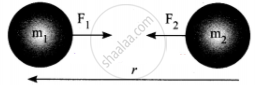
gravitational force between two masses
The force between the masses is always attractive and it does not depend on the medium where they are placed.
Let, m1 and m2 be the masses of two bodies A and B placed r metre apart in space.
Force F ∝ m1 × m2
F ∝ 1/r2
On combining the above two expressions
F ∝ `("m"_1xx"m"_2)/"r"^2`
F = `("Gm"_1"m"_2)/r^2`
Where G is the universal gravitational constant.
Its value in SI unit is 6.674 × 10⁻¹¹ Nm2 kg-2.
APPEARS IN
संबंधित प्रश्न
A rocket is fired from the earth towards the sun. At what distance from the earth’s centre is the gravitational force on the rocket zero? Mass of the sun = 2 ×1030 kg, mass of the earth = 6 × 1024 kg. Neglect the effect of other planets etc. (orbital radius = 1.5 × 10¹¹ m).
A solid sphere of mass m and radius r is placed inside a hollow thin spherical shell of mass M and radius R as shown in the following figure . A particle of mass m' is placed on the line joining the two centres at a distance x from the point of contact of the sphere and the shell. Find the magnitude of the resultant gravitational force on this particle due to the sphere and the shell if (a) r < x < 2r, (b) 2r < x < 2R and (c) x > 2R.
A ball is thrown vertically upwards. It goes to a height 20 m and then returns to the ground. Taking acceleration due to gravity g to be 10 ms-2, find: the initial velocity of the ball.
The acceleration produced by a force in an object is directly proportional to the applied _________ And inversely proportional to the _________ Of the object.
How will the force of gravitation between two objects change if the distance between them is:
Made four times
Two equal and opposite forces acting at the same point on a stationary body. Will the body move? Give reason to explain your answer.
Explain why:
The atmosphere does not escape.
The value of universal gravitational constant (G) in the SI unit is ______.
How is the gravitational force between two point masses affected when they are dipped in water keeping the separation between them the same?
Newton formulated the Universal Law of Gravitation by combining the ideas of which two scientists with his own Laws of Motion?
