Advertisements
Advertisements
प्रश्न
A rocket is fired from the earth towards the sun. At what distance from the earth’s centre is the gravitational force on the rocket zero? Mass of the sun = 2 ×1030 kg, mass of the earth = 6 × 1024 kg. Neglect the effect of other planets etc. (orbital radius = 1.5 × 10¹¹ m).
Advertisements
उत्तर १
Mass of the Sun, Ms = 2 × 1030 kg
Mass of the Earth, Me = 6 × 10 24 kg
Orbital radius, r = 1.5 × 10¹¹ m
Mass of the rocket = m
Let x be the distance from the centre of the Earth where the gravitational force acting on satellite P becomes zero.
From Newton’s law of gravitation, we can equate gravitational forces acting on satellite P under the influence of the Sun and the Earth as:
`(GmM_s)/(r-x)^2 = GmM_e/x^2`
((r-x)/x)^2 = `M_s/M_e`
`(r-x)/r = ((2xx10^(30))/(60xx10^(24)))^(1/2) = 577.35`
`1.5 xx 10^(11)-x=577.35x`
`x = (1.5xx10^11)/578.35` = `2.59 xx 10^8` m
उत्तर २
Mass of Sun, M = 2 x 1030 kg; Mass of Earth, m = 6 x 1024 kg Distance between Sim and Earth, r = 1.5 x 10¹¹ m
Let at the point P, the gravitational force on the rocket due to Earth = gravitional force on the rocket due to sun
Let x = distance of the point { from the Earth
Then `(Gm)/x^2 = (GM)/(r-x)^2`
`=>(r-x)^2/x^2 = M/m = (2xx10^(30))/(6xx10)^24 = 10^6/3`
or `(r-x)/x = 10^3/sqrt3 => r/x = 10^3/sqrt3 + 1 =~ 10^3/sqrt3`
or `x = (sqrt3r)/10^3 = (1.732xx1.5xx10^11)/10^3 = 2.6 xx 10^8` m
APPEARS IN
संबंधित प्रश्न
Write the answer of the question with reference to laws of gravitation.
State the universal law of gravitation.
How does the force of gravitation between two objects change when the distance between them is reduced to half?
Calculate the force of gravitation between the earth and the Sun, given that the mass of the earth = 6 × 1024 kg and of the Sun = 2 × 1030 kg. The average distance between the two is 1.5 × 10¹¹ m.
Answer the following:
You can shield a charge from electrical forces by putting it inside a hollow conductor. Can you shield a body from the gravitational influence of nearby matter by putting it inside a hollow sphere or by some other means?
Can you think of two particles which do not exert gravitational force on each other?
Derive an expression for the gravitational field due to a uniform rod of length L and mass M at a point on its perpendicular bisector at a distance d from the centre.
A tunnel is dug along a diameter of the earth. Find the force on a particle of mass m placed in the tunnel at a distance x from the centre.
The acceleration produced by a force in an object is directly proportional to the applied _________ And inversely proportional to the _________ Of the object.
Distinguish between gravity and gravitation
Name and state the action and reaction in the following case:
A book lying on a table.
Is there a gravitational attraction between you and the book? Explain.
Particles of masses 2M, m and M are respectively at points A, B and C with AB = ½ (BC). m is much-much smaller than M and at time t = 0, they are all at rest (Figure). At subsequent times before any collision takes place ______.

Molecules in air in the atmosphere are attracted by gravitational force of the earth. Explain why all of them do not fall into the earth just like an apple falling from a tree.
Write the answer of the question with reference to laws of gravitation.
Write the value of the universal gravitational constant.
Four identical particles of equal masses 1 kg made to move along the circumference of a circle of radius 1 m under the action of their own mutual gravitational attraction. The speed of each particle will be ______.
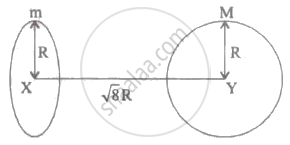
Find the gravitational force of attraction between the ring and sphere as shown in the diagram, where the plane of the ring is perpendicular to the line joining the centres. If `sqrt8` R is the distance between the centres of a ring (of mass 'm')and a sphere (mass 'M') where both have equal radius 'R'.
If the mass of one object is doubled and distance remains the same, the gravitational force will ______.
Ocean tides on Earth are mainly caused by ______.
