Advertisements
Advertisements
प्रश्न
A tunnel is dug along a chord of the earth at a perpendicular distance R/2 from the earth's centre. The wall of the tunnel may be assumed to be frictionless. Find the force exerted by the wall on a particle of mass m when it is at a distance x from the centre of the tunnel.
Advertisements
उत्तर
Let d be distance of the particle from the centre of the Earth.
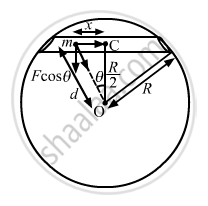
\[\text { Now }, d^2 = x^2 + \left( \frac{R^2}{4} \right) = \frac{4 x^2 + R^2}{4}\]
\[ \Rightarrow d = \left( \frac{1}{2} \right)\sqrt{4 x^2 + R^2}\]
Let M be the mass of the Earth and M' be the mass of the sphere of radius d.
Then we have :
\[M = \left( \frac{4}{3} \right)\pi R^3 \rho\]
\[ M^1 = \left( \frac{4}{3} \right)\pi d^3 \rho\]
\[ \therefore \frac{M^1}{M} = \frac{d^3}{R^3}\]
Gravitational force on the particle of mass m is given by
\[F = \frac{G M^1 m}{d^2}\]
\[ \Rightarrow F = \frac{G d^3 Mm}{R^3 d^2}\]
\[ \Rightarrow F = \frac{GMm}{R^3}d\]
∴ Normal force exerted by the wall, FN = F cos θ
\[= \frac{GMmd}{R^3} \times \frac{R}{2d} = \frac{GMm}{2 R^2}\]
APPEARS IN
संबंधित प्रश्न
Answer the following:
An astronaut inside a small space ship orbiting around the earth cannot detect gravity. If the space station orbiting around the earth has a large size, can he hope to detect gravity?
Can we apply Newton’s third law to the gravitational force ? Explain your answer.
Derive an expression for the gravitational field due to a uniform rod of length L and mass M at a point on its perpendicular bisector at a distance d from the centre.
Multiple Choice Question. Select the correct option.
The mass of earth is 6 × 1024 kg and radius of earth is 6.4 × 10⁶ m. The magnitude of force between the mass of 1 kg and the earth is:
Where will you weigh more: at the moon's surface or at the earth's surface?
What is meant by the equation :
`g= Gxxm/r^2`
where the symbols have their usual meanings.
A force can produce ________, In an object at rest. It can __________ an object and change its __________ of motion.
What does a force do in the following case?
You apply brakes to a running car.
What does a force do in the following case?
You catch a kicked ball.
You can change the direction in which an object is moving by___________.
Name and state the action and reaction in the following case:
A book lying on a table.
Why does a ball moving on a table top eventually stops?
Is there a gravitational attraction between you and the book? Explain.
State Newton's law of gravitation. What is the difference between:
Gravity and gravitation
Solve the following problem.
Calculate the acceleration due to gravity at a height of 300 km from the surface of the Earth. (M = 5.98 × 1024 kg, R = 6400 km).
If three equal masses m are placed at the three vertices of an equilateral triangle of side 1/m then what force acts on a particle of mass 2m placed at the centroid?
For an object outside a uniform solid sphere, from where is the sphere's mass considered to act?
Newton formulated the Universal Law of Gravitation by combining the ideas of which two scientists with his own Laws of Motion?
