Advertisements
Advertisements
प्रश्न
The mass of moon is about 0.012 times that of earth and its diameter is about 0.25 times that of earth. The value of G on the moon will be:
विकल्प
less than that on the earth
more than that on the earth
same as that on the earth
about one-sixth of that on the earth
Advertisements
उत्तर
Same as that of the earth
G is universal gravitational constant. So, it remains constant everywhere.
APPEARS IN
संबंधित प्रश्न
The earth and the moon are attracted to each other by gravitational force. Does the earth attract the moon with a force that is greater or smaller or the same as the force with which the moon attracts the earth? Why?
What happens to the force between two objects, if the mass of one object is doubled?
What is the importance of the universal law of gravitation?
State the universal law of gravitation. Name the scientist who gave this law.
Let V and E be the gravitational potential and gravitational field at a distance r from the centre of a uniform spherical shell. Consider the following two statements :
(A) The plot of V against r is discontinuous.
(B) The plot of E against r is discontinuous.
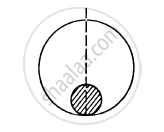
A solid sphere of mass m and radius r is placed inside a hollow thin spherical shell of mass M and radius R as shown in the following figure . A particle of mass m' is placed on the line joining the two centres at a distance x from the point of contact of the sphere and the shell. Find the magnitude of the resultant gravitational force on this particle due to the sphere and the shell if (a) r < x < 2r, (b) 2r < x < 2R and (c) x > 2R.
A ball is thrown up with a speed of 4.9 ms-1.
Calculate the time it takes to reach this height.
What does a force do in the following case?
You pull the skin of your arm
Mahendra and Virat are sitting at a distance of 1m from each other. Their masses are 75 kg and 80 kg respectively. What is the gravitational force between them? (G = 6.67 × 10⁻¹¹ Nm2/kg2)
Who measured the value of the Universal Gravitational Constant G using the Cavendish balance?
