Advertisements
Advertisements
प्रश्न
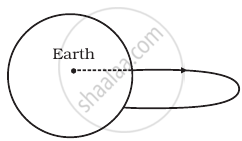
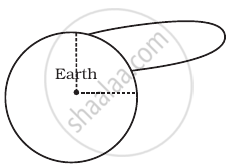
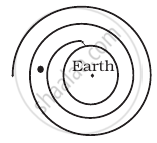
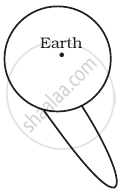
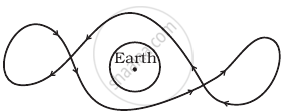
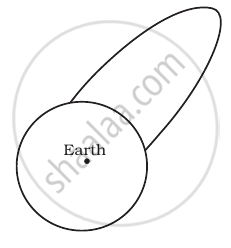
Shown are several curves (Figure). Explain with reason, which ones amongst them can be possible trajectories traced by a projectile (neglect air friction).
विकल्प
Advertisements
उत्तर
Explanation:
Here, the trajectory of path which is followed by the projectile under the gravitational force of earth will be a conic section or parabolic or elliptical or focus must be with centre. So, accordingly, only is required which shows centre of earth as focus of trajectory.
APPEARS IN
संबंधित प्रश्न
What happens to the force between two objects, if the distance between the objects is doubled and tripled?
Choose the correct alternative:
Acceleration due to gravity increases/decreases with increasing altitude.
Choose the correct alternative:
Acceleration due to gravity increases/decreases with increasing depth. (assume the earth to be a sphere of uniform density).
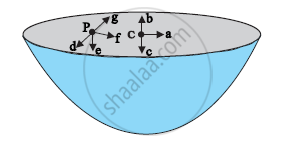
The gravitational intensity at the centre of a hemispherical shell of uniform mass density has the direction indicated by the arrow (see Fig 8.12) (i) a, (ii) b, (iii) c, (iv) 0.
How will you ‘weigh the sun’, that is estimate its mass? The mean orbital radius of the earth around the sun is 1.5 × 10⁸ km.
Can we apply Newton’s third law to the gravitational force ? Explain your answer.
A person sitting in a chair in a satellite feels weightless because
Two concentric spherical shells have masses M1, M2 and radii R1, R2 (R1 < R2). What is the force exerted by this system on a particle of mass m1 if it is placed at a distance (R1+ R2)/2 from the centre?
A tunnel is dug along a diameter of the earth. Find the force on a particle of mass m placed in the tunnel at a distance x from the centre.
A tunnel is dug along a chord of the earth at a perpendicular distance R/2 from the earth's centre. The wall of the tunnel may be assumed to be frictionless. Find the force exerted by the wall on a particle of mass m when it is at a distance x from the centre of the tunnel.
Multiple Choice Question. Select the correct option.
The mass of earth is 6 × 1024 kg and radius of earth is 6.4 × 10⁶ m. The magnitude of force between the mass of 1 kg and the earth is:
How will the force of gravitation between two objects change if the distance between them is:
Doubled
What does a force do in the following case?
You catch a kicked ball.
An apple falls towards the earth due to its gravitational force. The apple also attracts the earth with the same force. Why do we not see the earth rising towards the apple? Explain.
The gravitational force between two bodies is directly proportional to the product of the masses of those bodies and is ______ of the distance between them.
The force of gravitation between two bodies of mass 1 kg each separated by a distance of 1 m in vacuum is ____________.
Molecules in air in the atmosphere are attracted by gravitational force of the earth. Explain why all of them do not fall into the earth just like an apple falling from a tree.
The gravitational force between a hollow spherical shell (of radius R and uniform density) and a point mass is F. Show the nature of F vs r graph where r is the distance of the point from the centre of the hollow spherical shell of uniform density.
If the mass of one object is doubled and distance remains the same, the gravitational force will ______.
Ocean tides on Earth are mainly caused by ______.
