Advertisements
Advertisements
प्रश्न
Molecules in air in the atmosphere are attracted by gravitational force of the earth. Explain why all of them do not fall into the earth just like an apple falling from a tree.
Advertisements
उत्तर
Air molecules in the atmosphere are attracted by the gravitational force of the earth but they do not fall into the earth due to the reason that the molecules in air have some random motion due to temperature, so their resultant motion is not exactly the vertically downward direction.
But in the case of apples, only vertical motion dominates because of being heavier than air molecules. But due to gravity, the density of air is more near to the earth than the density as we go up.
APPEARS IN
संबंधित प्रश्न
What happens to the force between two objects, if the distance between the objects is doubled and tripled?
Choose the correct answer from among the given ones:
For the problem 8.10, the direction of the gravitational intensity at an arbitrary point P is indicated by the arrow (i) d, (ii) e, (iii) f, (iv) g.
Let V and E represent the gravitational potential and field at a distance r from the centre of a uniform solid sphere. Consider the two statements:
(A) the plot of V against r is discontinuous.
(B) The plot of E against r is discontinuous.
Four particles having masses m, 2m, 3m and 4m are placed at the four corners of a square of edge a. Find the gravitational force acting on a particle of mass m placed at the centre.
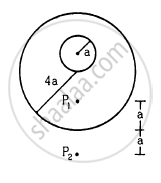
A uniform metal sphere of radius a and mass M is surrounded by a thin uniform spherical shell of equal mass and radius 4a (In the following figure). The centre of the shell falls on the surface of the inner sphere. Find the gravitational field at the points P1 and P2 shown in the figure.
How will the force of gravitation between two objects change if the distance between them is:
Doubled
The force of attraction between any two material objects is called __________.
Why does a ball moving on a table top eventually stops?
Two equal and opposite forces acting at the same point on a stationary body. Will the body move? Give reason to explain your answer.
What is the difference between gravity and gravitation?
Does the force of the earth's gravitation affect the motion of the moon? Explain your answer with reasons.
What do you mean by a gravitational constant?
The gravitational force between two bodies is directly proportional to the product of the masses of those bodies and is ______ of the distance between them.
State Newton’s universal law of gravitation. Express it with the mathematical form of force of gravitation?
Complete the chart below.
| F(N) | M1(kg) | M2(kg) | D(m) |
| (a) | 50 | 84 | 02 |
| 16 × 109 | 1.63 × 10²² | (b) | 34 |
Four identical particles of equal masses 1 kg made to move along the circumference of a circle of radius 1 m under the action of their own mutual gravitational attraction. The speed of each particle will be ______.
The Superposition Principle states that the net gravitational force on an object is ______.
A hollow spherical shell of uniform density exerts what gravitational force on a point mass placed inside it?
For an object outside a uniform solid sphere, from where is the sphere's mass considered to act?
