Advertisements
Advertisements
प्रश्न
Show that gravity decreases at higher altitudes.
Advertisements
उत्तर
We know that the law of gravitation is
F = G ( m1 x m2)/R2
Here the F is the force due to attraction and this force is equal to the weight of the body m2g.
So m2g = G ( m1 x m2)/R2
g= (G x m2)/R2.
Here R is the distance between the earth centre and the object centre. Now if we go on higher altitude say ‘H’ then this R would increase to (R + H)
And the value of gravity at height H becomes
g’= (G x m2)/( R + H)2.
As denominator increases so g’ would be less than g and hence we can say that gravity decreases at higher altitudes.
APPEARS IN
संबंधित प्रश्न
Write the answer of the question with reference to laws of gravitation.
State the universal law of gravitation.
Choose the correct alternative:
Acceleration due to gravity increases/decreases with increasing altitude.
State and explain Kepler's laws of planetary motion. Draw diagrams to illustrate these laws.
A particle of mass 100 g is kept on the surface of a uniform sphere of mass 10 kg and radius 10 cm. Find the work to be done against the gravitational force between them to take the particle away from the sphere.
Multiple Choice Question. Select the correct option.
The mass of earth is 6 × 1024 kg and radius of earth is 6.4 × 10⁶ m. The magnitude of force between the mass of 1 kg and the earth is:
The distance-time values for an object moving along straight line are given below:
| Time (s) | Distance (m) |
| 0 | 0 |
| 1 | 1 |
| 2 | 8 |
| 3 | 27 |
The ______ force is much weaker than other forces in nature.
State the universal law of gravitation and derive its mathematical expression.
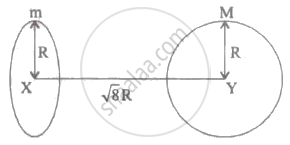
Find the gravitational force of attraction between the ring and sphere as shown in the diagram, where the plane of the ring is perpendicular to the line joining the centres. If `sqrt8` R is the distance between the centres of a ring (of mass 'm')and a sphere (mass 'M') where both have equal radius 'R'.
Newton formulated the Universal Law of Gravitation by combining the ideas of which two scientists with his own Laws of Motion?
