Advertisements
Advertisements
प्रश्न
An apple falls towards the earth due to its gravitational force. The apple also attracts the earth with the same force. Why do we not see the earth rising towards the apple? Explain.
Advertisements
उत्तर
Yes, it is true that apple attracts the earth towards it with same force but the mass of the earth is so huge that acceleration produced in it due to this force is very much small and negligible to notice
APPEARS IN
संबंधित प्रश्न
What happens to the force between two objects, if the distance between the objects is doubled and tripled?
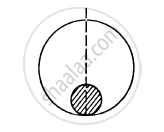
A solid sphere of mass m and radius r is placed inside a hollow thin spherical shell of mass M and radius R as shown in the following figure . A particle of mass m' is placed on the line joining the two centres at a distance x from the point of contact of the sphere and the shell. Find the magnitude of the resultant gravitational force on this particle due to the sphere and the shell if (a) r < x < 2r, (b) 2r < x < 2R and (c) x > 2R.
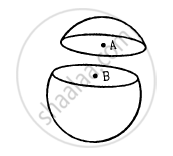
A thin spherical shell having uniform density is cut in two parts by a plane and kept separated as shown in the following figure. The point A is the centre of the plane section of the first part and B is the centre of the plane section of the second part. Show that the gravitational field at A due to the first part is equal in magnitude to the gravitational field at B due to the second part.
The acceleration produced by a force in an object is directly proportional to the applied _________ And inversely proportional to the _________ Of the object.
What does a force do in the following case?
You apply brakes to a running car.
What does a force do in the following case?
You catch a kicked ball.
Name and state the action and reaction in the following case:
A book lying on a table.
Answer the following question.
What are the dimensions of the universal gravitational constant?
To project the rockets which of the following principle(s) is /(are) required?
If the law of gravitation, instead of being inverse-square law, becomes an inverse-cube law- ______.
- planets will not have elliptic orbits.
- circular orbits of planets is not possible.
- projectile motion of a stone thrown by hand on the surface of the earth will be approximately parabolic.
- there will be no gravitational force inside a spherical shell of uniform density.
