Advertisements
Advertisements
प्रश्न
Define one Newton. How much maximum acceleration can it produce in a mass of 1 kg?
Advertisements
उत्तर
1 Newton is the force which when applied to a body of unit mass produces a unit acceleration in it. 1 newton would produce an acceleration of 1 ms-2 in a mass of 1 kg.
APPEARS IN
संबंधित प्रश्न
What happens to the force between two objects, if the masses of both objects are doubled?
Choose the correct alternative:
Acceleration due to gravity increases/decreases with increasing altitude.
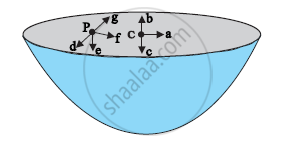
The gravitational intensity at the centre of a hemispherical shell of uniform mass density has the direction indicated by the arrow (see Fig 8.12) (i) a, (ii) b, (iii) c, (iv) 0.
Can we apply Newton’s third law to the gravitational force ? Explain your answer.
Suppose the gravitational potential due to a small system is k/r2 at a distance r from it. What will be the gravitational field? Can you think of any such system? What happens if there were negative masses?
Two spherical balls of mass 10 kg each are placed 10 cm apart. Find the gravitational force of attraction between them.
Derive an expression for the gravitational field due to a uniform rod of length L and mass M at a point on its perpendicular bisector at a distance d from the centre.
Explain the following:
People often shake the branches of a tree for getting down its fruits.
To project the rockets which of the following principle(s) is /(are) required?
The acceleration of the Moon towards the Earth is approximately ______.
