Advertisements
Advertisements
प्रश्न
How will the force of gravitation between two objects change if the distance between them is:
Doubled
Advertisements
उत्तर
We know that law of gravitation.
F = G ( m1 X m2)/R2.
If distance between them is doubled then put R = 2R.
F = G( m1 X m2)/ 4R2.
F1 = F/4.
APPEARS IN
संबंधित प्रश्न
Write the three laws given by Kepler. How did they help Newton to arrive at the inverse square law of gravity?
Two small bodies of masses 10 kg and 20 kg are kept a distance 1.0 m apart and released. Assuming that only mutual gravitational forces are acting, find the speeds of the particles when the separation decreases to 0.5 m.
A ball is thrown up with a speed of 4.9 ms-1.
Calculate the maximum height it would gain before it begins to fall.
You can change the direction in which an object is moving by___________.
Name and state the action and reaction in the following case:
A person walking on the ground.
Solve the following problem.
Calculate the acceleration due to gravity at a height of 300 km from the surface of the Earth. (M = 5.98 × 1024 kg, R = 6400 km).
Three uniform spheres, each having mass m and radius r, are kept in such a way that each touches the other two. The magnitude of the gravitational force on any sphere due to the other two is
We can shield a charge from electric fields by putting it inside a hollow conductor. Can we shield a body from the gravitational influence of nearby matter by putting it inside a hollow sphere or by some other means?
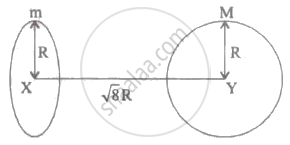
Find the gravitational force of attraction between the ring and sphere as shown in the diagram, where the plane of the ring is perpendicular to the line joining the centres. If `sqrt8` R is the distance between the centres of a ring (of mass 'm')and a sphere (mass 'M') where both have equal radius 'R'.
The acceleration of the Moon towards the Earth is approximately ______.
