Advertisements
Advertisements
प्रश्न
As observed from earth, the sun appears to move in an approximate circular orbit. For the motion of another planet like mercury as observed from earth, this would ______.
विकल्प
be similarly true.
not be true because the force between earth and mercury is not inverse square law.
not be true because the major gravitational force on mercury is due to sun.
not be true because mercury is influenced by forces other than gravitational forces.
Advertisements
उत्तर
As observed from earth, the sun appears to move in an approximate circular orbit. For the motion of another planet like mercury as observed from earth, this would not be true because the major gravitational force on mercury is due to sun.
Explanation:
As observed from the earth, the sun appears to move in an approximately circular orbit. The gravitational force of attraction between the earth and the sun always follows the inverse square law. All planets move around the sun due to the huge gravitational force of the sun acting on them. The gravitational force on the mercury due to the earth is much smaller as compared to that acting on it due to the sun and hence it revolves around the sun and not around the earth.
APPEARS IN
संबंधित प्रश्न
Choose the correct alternative:
Acceleration due to gravity is independent of mass of the earth/mass of the body.
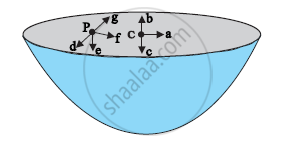
The gravitational intensity at the centre of a hemispherical shell of uniform mass density has the direction indicated by the arrow (see Fig 8.12) (i) a, (ii) b, (iii) c, (iv) 0.
Two spherical balls of mass 10 kg each are placed 10 cm apart. Find the gravitational force of attraction between them.
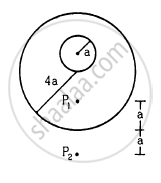
A uniform metal sphere of radius a and mass M is surrounded by a thin uniform spherical shell of equal mass and radius 4a (In the following figure). The centre of the shell falls on the surface of the inner sphere. Find the gravitational field at the points P1 and P2 shown in the figure.
The law of gravitation gives the gravitational force between :
State whether the gravitational force between two masses is attractive or repulsive ?
A ball is thrown vertically upwards. It goes to a height 20 m and then returns to the ground. Taking acceleration due to gravity g to be 10 ms-2 , find :
the total time of journey of the ball .
Multiple Choice Question. Select the correct option.
The mass of earth is 6 × 1024 kg and radius of earth is 6.4 × 10⁶ m. The magnitude of force between the mass of 1 kg and the earth is:
How will the force of gravitation between two objects change if the distance between them is:
Made four times
The force of attraction between any two material objects is called __________.
Why don't you feel the force of attraction between your friend sitting close to you and yourself?
Is there a gravitational attraction between you and the book? Explain.
An apple falls towards the earth due to its gravitational force. The apple also attracts the earth with the same force. Why do we not see the earth rising towards the apple? Explain.
The distance-time values for an object moving along straight line are given below:
| Time (s) | Distance (m) |
| 0 | 0 |
| 1 | 1 |
| 2 | 8 |
| 3 | 27 |
State Newton’s universal law of gravitation. Express it with the mathematical form of force of gravitation?
Answer the following questions in reference to the figure below:

- Which relation is shown in the figure?
- What will happen if the mass of one of the objects is doubled?
Two particles of equal mass 'm' go around a circle of radius R under the action of their mutual gravitational attraction. The speed of each particle with respect to its centre of mass is ______.
Newton formulated the Universal Law of Gravitation by combining the ideas of which two scientists with his own Laws of Motion?
The gravitational force between two objects acts in which direction?
