Advertisements
Advertisements
प्रश्न
Different points in earth are at slightly different distances from the sun and hence experience different forces due to gravitation. For a rigid body, we know that if various forces act at various points in it, the resultant motion is as if a net force acts on the c.m. (centre of mass) causing translation and a net torque at the c.m. causing rotation around an axis through the c.m. For the earth-sun system (approximating the earth as a uniform density sphere).
विकल्प
the torque is zero.
the torque causes the earth to spin.
the rigid body result is not applicable since the earth is not even approximately a rigid body.
the torque causes the earth to move around the sun.
Advertisements
उत्तर
The torque is zero.
Explanation:
As the earth is revolving around the sun in a circular motion due to gravitational attraction. The force of attraction will be of radial nature i.e., the angle between position vector r and force F is zero. So, torque = |τ| = |r × F| = rFsin0° = 0.
APPEARS IN
संबंधित प्रश्न
Calculate the force of gravitation between the earth and the Sun, given that the mass of the earth = 6 × 1024 kg and of the Sun = 2 × 1030 kg. The average distance between the two is 1.5 × 10¹¹ m.
At noon, the sun and the earth pull the objects on the earth's surface in opposite directions. At midnight, the sun and the earth pull these objects in same direction. Is the weight of an object, as measured by a spring balance on the earth's surface, more at midnight as compared to its weight at noon?
Inside a uniform spherical shell
(a) the gravitational potential is zero
(b) the gravitational field is zero
(c) the gravitational potential is same everywhere
(d) the gravitational field is same everywhere
Consider a planet moving in an elliptical orbit round the sun. The work done on the planet by the gravitational force of the sun
(a) is zero in any small part of the orbit
(b) is zero in some parts of the orbit
(c) is zero in one complete revolution
(d) is zero in no part of the motion.
Which of the following quantities remain constant in a planetary motion (consider elliptical orbits) as seen from the sun?
Four particles of equal masses M move along a circle of radius R under the action of their mutual gravitational attraction. Find the speed of each particle.
Two concentric spherical shells have masses M1, M2 and radii R1, R2 (R1 < R2). What is the force exerted by this system on a particle of mass m1 if it is placed at a distance (R1+ R2)/2 from the centre?
The mass of moon is about 0.012 times that of earth and its diameter is about 0.25 times that of earth. The value of G on the moon will be:
State whether the gravitational force between two masses is attractive or repulsive ?
Who stated the law of gravitation?
Distinguish between gravity and gravitation
The force of attraction between any two material objects is called __________.
A ball is thrown up with a speed of 4.9 ms-1.
Calculate the maximum height it would gain before it begins to fall.
State the universal law of gravitation and derive its mathematical expression.
Law of gravitation gives the gravitational force between
If the law of gravitation, instead of being inverse-square law, becomes an inverse-cube law- ______.
- planets will not have elliptic orbits.
- circular orbits of planets is not possible.
- projectile motion of a stone thrown by hand on the surface of the earth will be approximately parabolic.
- there will be no gravitational force inside a spherical shell of uniform density.
Six point masses of mass m each are at the vertices of a regular hexagon of side l. Calculate the force on any of the masses.
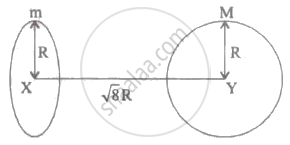
Find the gravitational force of attraction between the ring and sphere as shown in the diagram, where the plane of the ring is perpendicular to the line joining the centres. If `sqrt8` R is the distance between the centres of a ring (of mass 'm')and a sphere (mass 'M') where both have equal radius 'R'.
The gravitational force between two objects acts in which direction?
