Advertisements
Advertisements
प्रश्न
Multiple Choice Question. Select the correct option.
The mass of earth is 6 × 1024 kg and radius of earth is 6.4 × 10⁶ m. The magnitude of force between the mass of 1 kg and the earth is:
विकल्प
9.770 N
9.810 N
830 N
9.790 N
Advertisements
उत्तर
9.770 N
Explanation:
Mass of earth = m1 = 6 × 1024 kg
Mass of the body = m2 = 1 kg
Radius of earth = r = 6.4 × 10⁶ m
Universal gravitational constant = G = 6.67 × 10⁻¹¹ Nm2 kg−2
Force = F = ?
F = `("G m"_1 "m"_2)/"r"^2=(6.67xx10^-11xx6xx10^24xx1)/(6.4xx10^6)^2`
= `(6.67xx6xx10^(-11-12+24))/(6.4xx6.4)`
F = `(6.67xx6xx10)/(6.4xx6.4)`
F = 9.770 N
APPEARS IN
संबंधित प्रश्न
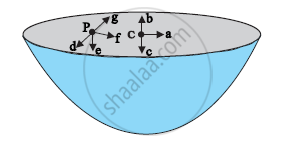
The gravitational intensity at the centre of a hemispherical shell of uniform mass density has the direction indicated by the arrow (see Fig 8.12) (i) a, (ii) b, (iii) c, (iv) 0.
Can we apply Newton’s third law to the gravitational force ? Explain your answer.
A person sitting in a chair in a satellite feels weightless because
Consider a planet moving in an elliptical orbit round the sun. The work done on the planet by the gravitational force of the sun
(a) is zero in any small part of the orbit
(b) is zero in some parts of the orbit
(c) is zero in one complete revolution
(d) is zero in no part of the motion.
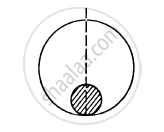
A solid sphere of mass m and radius r is placed inside a hollow thin spherical shell of mass M and radius R as shown in the following figure . A particle of mass m' is placed on the line joining the two centres at a distance x from the point of contact of the sphere and the shell. Find the magnitude of the resultant gravitational force on this particle due to the sphere and the shell if (a) r < x < 2r, (b) 2r < x < 2R and (c) x > 2R.
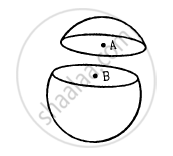
A thin spherical shell having uniform density is cut in two parts by a plane and kept separated as shown in the following figure. The point A is the centre of the plane section of the first part and B is the centre of the plane section of the second part. Show that the gravitational field at A due to the first part is equal in magnitude to the gravitational field at B due to the second part.
The mass of moon is about 0.012 times that of earth and its diameter is about 0.25 times that of earth. The value of G on the moon will be:
A ball is thrown vertically upwards. It goes to a height 20 m and then returns to the ground. Taking acceleration due to gravity g to be 10 ms-2, find: the initial velocity of the ball.
The force of attraction between any two material objects is called __________.
Who measured the value of the Universal Gravitational Constant G using the Cavendish balance?
