Advertisements
Advertisements
प्रश्न
Different points in earth are at slightly different distances from the sun and hence experience different forces due to gravitation. For a rigid body, we know that if various forces act at various points in it, the resultant motion is as if a net force acts on the c.m. (centre of mass) causing translation and a net torque at the c.m. causing rotation around an axis through the c.m. For the earth-sun system (approximating the earth as a uniform density sphere).
पर्याय
the torque is zero.
the torque causes the earth to spin.
the rigid body result is not applicable since the earth is not even approximately a rigid body.
the torque causes the earth to move around the sun.
Advertisements
उत्तर
The torque is zero.
Explanation:
As the earth is revolving around the sun in a circular motion due to gravitational attraction. The force of attraction will be of radial nature i.e., the angle between position vector r and force F is zero. So, torque = |τ| = |r × F| = rFsin0° = 0.
APPEARS IN
संबंधित प्रश्न
Answer the following:
An astronaut inside a small space ship orbiting around the earth cannot detect gravity. If the space station orbiting around the earth has a large size, can he hope to detect gravity?
A rocket is fired from the earth towards the sun. At what distance from the earth’s centre is the gravitational force on the rocket zero? Mass of the sun = 2 ×1030 kg, mass of the earth = 6 × 1024 kg. Neglect the effect of other planets etc. (orbital radius = 1.5 × 10¹¹ m).
Which of the Kepler’s laws of planetary motion led Newton to establish the inverse-square rule for gravitational force between two bodies ?
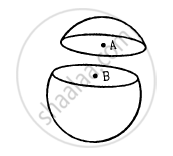
A thin spherical shell having uniform density is cut in two parts by a plane and kept separated as shown in the following figure. The point A is the centre of the plane section of the first part and B is the centre of the plane section of the second part. Show that the gravitational field at A due to the first part is equal in magnitude to the gravitational field at B due to the second part.
The law of gravitation gives the gravitational force between :
What does a force do in the following case?
You catch a kicked ball.
Name and state the action and reaction in the following case:
A book lying on a table.
State the law of gravitation. Why is it called universal?
Does the force of the earth's gravitation affect the motion of the moon? Explain your answer with reasons.
State Newton's law of gravitation. What is the difference between:
Gravity and gravitation
State Newton's law of gravitation. What is the difference between:
g and G?
Solve the following problem.
Find the gravitational force between the Sun and the Earth.
Given Mass of the Sun = 1.99 × 1030 kg
Mass of the Earth = 5.98 × 1024 kg
The average distance between the Earth and the Sun = 1.5 × 10¹¹ m.
The gravitational force between two bodies is directly proportional to the product of the masses of those bodies and is ______ of the distance between them.
To project the rockets which of the following principle(s) is /(are) required?
Choose the wrong option.
Answer the following questions in reference to the figure below:

- Which relation is shown in the figure?
- What will happen if the mass of one of the objects is doubled?
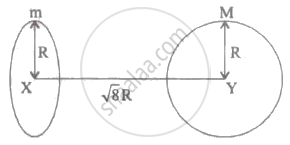
Find the gravitational force of attraction between the ring and sphere as shown in the diagram, where the plane of the ring is perpendicular to the line joining the centres. If `sqrt8` R is the distance between the centres of a ring (of mass 'm')and a sphere (mass 'M') where both have equal radius 'R'.
The acceleration of the Moon towards the Earth is approximately ______.
If the distance between two objects is doubled, the gravitational force becomes ______.
