Advertisements
Advertisements
प्रश्न
A tunnel is dug along a chord of the earth at a perpendicular distance R/2 from the earth's centre. The wall of the tunnel may be assumed to be frictionless. Find the force exerted by the wall on a particle of mass m when it is at a distance x from the centre of the tunnel.
Advertisements
उत्तर
Let d be distance of the particle from the centre of the Earth.
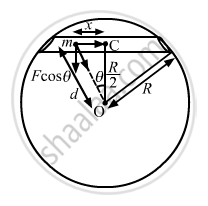
\[\text { Now }, d^2 = x^2 + \left( \frac{R^2}{4} \right) = \frac{4 x^2 + R^2}{4}\]
\[ \Rightarrow d = \left( \frac{1}{2} \right)\sqrt{4 x^2 + R^2}\]
Let M be the mass of the Earth and M' be the mass of the sphere of radius d.
Then we have :
\[M = \left( \frac{4}{3} \right)\pi R^3 \rho\]
\[ M^1 = \left( \frac{4}{3} \right)\pi d^3 \rho\]
\[ \therefore \frac{M^1}{M} = \frac{d^3}{R^3}\]
Gravitational force on the particle of mass m is given by
\[F = \frac{G M^1 m}{d^2}\]
\[ \Rightarrow F = \frac{G d^3 Mm}{R^3 d^2}\]
\[ \Rightarrow F = \frac{GMm}{R^3}d\]
∴ Normal force exerted by the wall, FN = F cos θ
\[= \frac{GMmd}{R^3} \times \frac{R}{2d} = \frac{GMm}{2 R^2}\]
APPEARS IN
संबंधित प्रश्न
How does the force of gravitation between two objects change when the distance between them is reduced to half?
What is the magnitude of the gravitational force between the earth and a 1 kg object on its surface? (Mass of the earth is 6 × 1024 kg and radius of the earth is 6.4 × 10⁶ m).
State Kepler’s law which is represented by the relation r3 ∝ T2.
A tunnel is dug along a diameter of the earth. Find the force on a particle of mass m placed in the tunnel at a distance x from the centre.
A ball is thrown vertically upwards. It goes to a height 20 m and then returns to the ground. Taking acceleration due to gravity g to be 10 ms-2 , find :
the final velocity of the ball on reaching the ground .
Distinguish between gravity and gravitation
How will the force of gravitation between two objects change if the distance between them is:
Doubled
Why don't you feel the force of attraction between your friend sitting close to you and yourself?
Name and state the action and reaction in the following case:
A book lying on a table.
Two equal and opposite forces acting at the same point on a stationary body. Will the body move? Give reason to explain your answer.
State the law of gravitation. Why is it called universal?
State Newton's law of gravitation. What is the difference between:
Gravity and gravitation
Solve the following problem.
Find the gravitational force between the Sun and the Earth.
Given Mass of the Sun = 1.99 × 1030 kg
Mass of the Earth = 5.98 × 1024 kg
The average distance between the Earth and the Sun = 1.5 × 10¹¹ m.
Mahendra and Virat are sitting at a distance of 1m from each other. Their masses are 75 kg and 80 kg respectively. What is the gravitational force between them? (G = 6.67 × 10⁻¹¹ Nm2/kg2)
To project the rockets which of the following principle(s) is /(are) required?
Give the applications of universal law gravitation.
Law of gravitation gives the gravitational force between
How is the gravitational force between two point masses affected when they are dipped in water keeping the separation between them the same?
Write the answer of the question with reference to laws of gravitation.
Write the value of the universal gravitational constant.
Two particles of equal mass 'm' go around a circle of radius R under the action of their mutual gravitational attraction. The speed of each particle with respect to its centre of mass is ______.
