Advertisements
Advertisements
प्रश्न
The weight of an object is more at the poles than at the equator. Is it beneficial to purchase goods at equator and sell them at the pole? Does it matter whether a spring balance is used or an equal-beam balance is used?
Advertisements
उत्तर
The weight of an object is more at the poles than that at the equator. In purchasing or selling goods, we measure the mass of the goods. The balance used to measure the mass is calibrated according to the place to give its correct reading. So, it is not beneficial to purchase goods at the equator and sell them at the poles. A beam balance measures the mass of an object, so it can be used here. For using a spring balance, we need to calibrate it according to the place to give the correct readings.
APPEARS IN
संबंधित प्रश्न
What is the importance of the universal law of gravitation?
Choose the correct alternative:
Acceleration due to gravity increases/decreases with increasing altitude.
Choose the correct answer from among the given ones:
For the problem 8.10, the direction of the gravitational intensity at an arbitrary point P is indicated by the arrow (i) d, (ii) e, (iii) f, (iv) g.
A rocket is fired from the earth towards the sun. At what distance from the earth’s centre is the gravitational force on the rocket zero? Mass of the sun = 2 ×1030 kg, mass of the earth = 6 × 1024 kg. Neglect the effect of other planets etc. (orbital radius = 1.5 × 10¹¹ m).
Can we apply Newton’s third law to the gravitational force ? Explain your answer.
Inside a uniform spherical shell
(a) the gravitational potential is zero
(b) the gravitational field is zero
(c) the gravitational potential is same everywhere
(d) the gravitational field is same everywhere
Which of the following quantities remain constant in a planetary motion (consider elliptical orbits) as seen from the sun?
Three equal masses m are placed at the three corners of an equilateral triangle of side a. Find the force exerted by this system on another particle of mass m placed at (a) the mid-point of a side, (b) at the centre of the triangle.
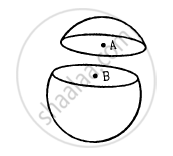
A thin spherical shell having uniform density is cut in two parts by a plane and kept separated as shown in the following figure. The point A is the centre of the plane section of the first part and B is the centre of the plane section of the second part. Show that the gravitational field at A due to the first part is equal in magnitude to the gravitational field at B due to the second part.
Who stated the law of gravitation?
Distinguish between gravity and gravitation
A ball is thrown up with a speed of 4.9 ms-1.
Prove that the time of ascent is equal to the time of descent.
The distance-time values for an object moving along straight line are given below:
| Time (s) | Distance (m) |
| 0 | 0 |
| 1 | 1 |
| 2 | 8 |
| 3 | 27 |
Answer the following question.
State Newton’s law of gravitation and express it in vector form.
Solve the following problem.
Calculate the acceleration due to gravity at a height of 300 km from the surface of the Earth. (M = 5.98 × 1024 kg, R = 6400 km).
We can shield a charge from electric fields by putting it inside a hollow conductor. Can we shield a body from the gravitational influence of nearby matter by putting it inside a hollow sphere or by some other means?
Write the answer of the question with reference to laws of gravitation.
Write the value of the universal gravitational constant.
Who measured the value of the Universal Gravitational Constant G using the Cavendish balance?
For an object outside a uniform solid sphere, from where is the sphere's mass considered to act?
