Advertisements
Advertisements
प्रश्न
If the law of gravitation, instead of being inverse-square law, becomes an inverse-cube law- ______.
- planets will not have elliptic orbits.
- circular orbits of planets is not possible.
- projectile motion of a stone thrown by hand on the surface of the earth will be approximately parabolic.
- there will be no gravitational force inside a spherical shell of uniform density.
Advertisements
उत्तर
a and c
Explanation:
If the law of gravitation becomes an inverse cube law. then we can write, for a planet of mass m revolving around the sun of mass M,
F = `(GMm)/a^3 = (mv^2)/a` .....(Where a is the radius of orbiting planet)
⇒ v = orbital speed = `sqrt(GM)/a`
⇒ `v ∝ 1/a`
Time period of revolution of a planet T = `(2πa)/v = (2πa)/(sqrt(GM)/a) = (2πa^2)/sqrt(GM)`
⇒ `T^2 ∝ a^4`
Hence, the orbit will not be elliptical. .....[For elliptical orbit T2 ∝ a3]
As force F = `((GM)/a^3)m = g m`
Where, `g^' = (GM)/a^3`
As g', acceleration due to gravity is constant, hence path followed by a projectile will be approximately parabolic. (as T ∝ a2)
APPEARS IN
संबंधित प्रश्न
What happens to the force between two objects, if the masses of both objects are doubled?
Calculate the force of gravitation between the earth and the Sun, given that the mass of the earth = 6 × 1024 kg and of the Sun = 2 × 1030 kg. The average distance between the two is 1.5 × 10¹¹ m.
Choose the correct alternative:
Acceleration due to gravity increases/decreases with increasing depth. (assume the earth to be a sphere of uniform density).
Universal law of gravitation states that every object exerts a gravitational force of attraction on every other object. If this is true, why don’t we notice such forces ? Why don’t the two objects in a room move towards each other due to this force ?
Can two particles be in equilibrium under the action of their mutual gravitational force? Can three particles be? Can one of the three particles be?
A body is suspended from a spring balance kept in a satellite. The reading of the balance is W1 when the satellite goes in an orbit of radius R and is W2 when it goes in an orbit of radius 2 −R.
Two spherical balls of mass 10 kg each are placed 10 cm apart. Find the gravitational force of attraction between them.
Three uniform spheres each having a mass M and radius a are kept in such a way that each touches the other two. Find the magnitude of the gravitational force on any of the spheres due to the other two.
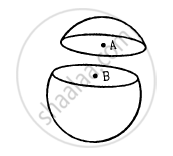
A thin spherical shell having uniform density is cut in two parts by a plane and kept separated as shown in the following figure. The point A is the centre of the plane section of the first part and B is the centre of the plane section of the second part. Show that the gravitational field at A due to the first part is equal in magnitude to the gravitational field at B due to the second part.
How will the force of gravitation between two objects change if the distance between them is:
Doubled
At what height above the earth's surface would the value of acceleration due to gravity be half of what it is on the surface? Take the radius of earth to be R.
What does a force do in the following case?
You apply brakes to a running car.
Name and state the action and reaction in the following case:
Hammering a nail.
State Newton's law of gravitation. What is the difference between:
g and G?
Answer the following question.
What are the dimensions of the universal gravitational constant?
Law of gravitation gives the gravitational force between
How is the gravitational force between two point masses affected when they are dipped in water keeping the separation between them the same?
We can shield a charge from electric fields by putting it inside a hollow conductor. Can we shield a body from the gravitational influence of nearby matter by putting it inside a hollow sphere or by some other means?
Two particles of equal mass 'm' go around a circle of radius R under the action of their mutual gravitational attraction. The speed of each particle with respect to its centre of mass is ______.
If the distance between two objects is doubled, the gravitational force becomes ______.
