Advertisements
Advertisements
प्रश्न
What happens to the force between two objects, if the distance between the objects is doubled and tripled?
Advertisements
उत्तर
If the distance between the two objects is doubled, then
F'' = `(Gm_1m_2)/(2R^2)`
= `1/4 xx (Gm_1m_2)/(R^2)`
= `1/4` F
= `F/4`
Thus, the gravitational force between the two objects becomes one-fourth.
If the distance between the two objects is tripled, then
F′′′ = `(Gm_1m_2)/(3R)^2`
= `1/9 xx (Gm_1m_2)/R^2`
= `1/9 xx F`
= `F/9`
Thus, the gravitational force between the two objects becomes one-ninth.
संबंधित प्रश्न
At noon, the sun and the earth pull the objects on the earth's surface in opposite directions. At midnight, the sun and the earth pull these objects in same direction. Is the weight of an object, as measured by a spring balance on the earth's surface, more at midnight as compared to its weight at noon?
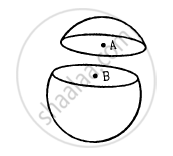
A thin spherical shell having uniform density is cut in two parts by a plane and kept separated as shown in the following figure. The point A is the centre of the plane section of the first part and B is the centre of the plane section of the second part. Show that the gravitational field at A due to the first part is equal in magnitude to the gravitational field at B due to the second part.
A particle of mass 100 g is kept on the surface of a uniform sphere of mass 10 kg and radius 10 cm. Find the work to be done against the gravitational force between them to take the particle away from the sphere.
How will the force of gravitation between two objects change if the distance between them is:
Halved
The force of attraction between any two material objects is called __________.
A ball is thrown up with a speed of 4.9 ms-1.
Calculate the maximum height it would gain before it begins to fall.
What is meant by the equation :
`g= Gxxm/r^2`
where the symbols have their usual meanings.
State the law of gravitation. Why is it called universal?
The ______ force is much weaker than other forces in nature.
State the universal law of gravitation and derive its mathematical expression.
