Advertisements
Advertisements
Question
What happens to the force between two objects, if the distance between the objects is doubled and tripled?
Advertisements
Solution
If the distance between the two objects is doubled, then
F'' = `(Gm_1m_2)/(2R^2)`
= `1/4 xx (Gm_1m_2)/(R^2)`
= `1/4` F
= `F/4`
Thus, the gravitational force between the two objects becomes one-fourth.
If the distance between the two objects is tripled, then
F′′′ = `(Gm_1m_2)/(3R)^2`
= `1/9 xx (Gm_1m_2)/R^2`
= `1/9 xx F`
= `F/9`
Thus, the gravitational force between the two objects becomes one-ninth.
RELATED QUESTIONS
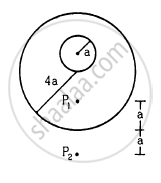
A uniform metal sphere of radius a and mass M is surrounded by a thin uniform spherical shell of equal mass and radius 4a (In the following figure). The centre of the shell falls on the surface of the inner sphere. Find the gravitational field at the points P1 and P2 shown in the figure.
Define one Newton. How much maximum acceleration can it produce in a mass of 1 kg?
A ball is thrown up with a speed of 4.9 ms-1.
Calculate the maximum height it would gain before it begins to fall.
A force can produce ________, In an object at rest. It can __________ an object and change its __________ of motion.
What does a force do in the following case?
You pull the skin of your arm
Name and state the action and reaction in the following case:
Hammering a nail.
What is the difference between gravity and gravitation?
Give the applications of universal law gravitation.
Six point masses of mass m each are at the vertices of a regular hexagon of side l. Calculate the force on any of the masses.
Answer the following questions in reference to the figure below:

- Which relation is shown in the figure?
- What will happen if the mass of one of the objects is doubled?
