Advertisements
Advertisements
Question
Six point masses of mass m each are at the vertices of a regular hexagon of side l. Calculate the force on any of the masses.
Advertisements
Solution
Consider the diagram below, in which six point masses are placed at six verticles A, B, C, D, E and F.
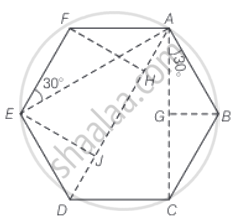
AC = AG + GC = 2AG
= `2l cos 30^circ`
= `2l sqrt(3)/2`
= `sqrt(3)l`
= AE
AD = AH + HJ + JD
= `l sin 30^circ + l + l sin 30^circ`
= `2l`
Force on mass m at A due to mass m at B is, `f_1 = (Gmm)/l^2` = along AB.
Force on mass m at A due to mass m at C is, `f_2 = (Gm xx m)/(sqrt(3)l)^2 = (Gm^2)/(3l^2)` along AC. ......[∵ AC = `sqrt(2)`l]
Force on mass m at A due to mass m at D is, `f_3 = (Gm xx m)/(2l)^2 = (Gm^2)/(4l^2)` along AD ......[∵ AD = 2l]
Force on mass m at A due to mass m at E is, `f_4 = (Gm xx m)/(sqrt(3)l)^2 = (Gm^2)/(3l^2)` along AE.
Force on mass m at A due to mass m at F is, `f_5 = (Gm xx m)/l^2 = (Gm^2)/l^2`along AF.
Resultant force due to `f_1` and `f_5` is `F_1 = sqrt(f_1^2 + f_5^2 + 2f_1f_5 cos 120^circ) = (Gm^2)/l^2` along AD. ...........[∵ Angle between `f_1` and `f_2` = 120°]
Resultant force due to `f_2` and `f_4` is `F_2 = sqrt(f_2^2 + f_4^2 + 2f_2f_4 cos 60^circ) = (sqrt(3)Gm^2)/(3l^2) = (Gm^2)/(sqrt(3)l^2)`along AD.
So, net force along AD = `F_1 + F_2 + F_3`
= `(Gm^2)/l^2 + (Gm^2)/(sqrt(3)l^2) + (Gm^2)/(4l^2)`
= `(Gm^2)/l^2 (1 + 1/sqrt(3) + 1/4)`
APPEARS IN
RELATED QUESTIONS
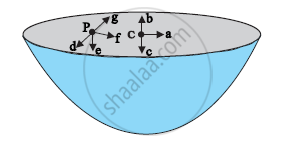
The gravitational intensity at the centre of a hemispherical shell of uniform mass density has the direction indicated by the arrow (see Fig 8.12) (i) a, (ii) b, (iii) c, (iv) 0.
A rocket is fired from the earth towards the sun. At what distance from the earth’s centre is the gravitational force on the rocket zero? Mass of the sun = 2 ×1030 kg, mass of the earth = 6 × 1024 kg. Neglect the effect of other planets etc. (orbital radius = 1.5 × 10¹¹ m).
Can we apply Newton’s third law to the gravitational force ? Explain your answer.
Can two particles be in equilibrium under the action of their mutual gravitational force? Can three particles be? Can one of the three particles be?
At noon, the sun and the earth pull the objects on the earth's surface in opposite directions. At midnight, the sun and the earth pull these objects in same direction. Is the weight of an object, as measured by a spring balance on the earth's surface, more at midnight as compared to its weight at noon?
Let V and E represent the gravitational potential and field at a distance r from the centre of a uniform solid sphere. Consider the two statements:
(A) the plot of V against r is discontinuous.
(B) The plot of E against r is discontinuous.
Four particles of equal masses M move along a circle of radius R under the action of their mutual gravitational attraction. Find the speed of each particle.
A tunnel is dug along a diameter of the earth. Find the force on a particle of mass m placed in the tunnel at a distance x from the centre.
How will the force of gravitation between two objects change if the distance between them is:
Doubled
All objects in the universe attract each other along the line joining their________.
You can change the direction in which an object is moving by___________.
Two equal and opposite forces acting at the same point on a stationary body. Will the body move? Give reason to explain your answer.
Does the force of the earth's gravitation affect the motion of the moon? Explain your answer with reasons.
Answer the following question.
What are the dimensions of the universal gravitational constant?
If the law of gravitation, instead of being inverse-square law, becomes an inverse-cube law- ______.
- planets will not have elliptic orbits.
- circular orbits of planets is not possible.
- projectile motion of a stone thrown by hand on the surface of the earth will be approximately parabolic.
- there will be no gravitational force inside a spherical shell of uniform density.
Shown are several curves (Figure). Explain with reason, which ones amongst them can be possible trajectories traced by a projectile (neglect air friction).
Write the answer of the question with reference to laws of gravitation.
Write the value of the universal gravitational constant.
Answer the following questions in reference to the figure below:

- Which relation is shown in the figure?
- What will happen if the mass of one of the objects is doubled?
Two particles of equal mass 'm' go around a circle of radius R under the action of their mutual gravitational attraction. The speed of each particle with respect to its centre of mass is ______.
Newton formulated the Universal Law of Gravitation by combining the ideas of which two scientists with his own Laws of Motion?
