Advertisements
Advertisements
प्रश्न
Six point masses of mass m each are at the vertices of a regular hexagon of side l. Calculate the force on any of the masses.
Advertisements
उत्तर
Consider the diagram below, in which six point masses are placed at six verticles A, B, C, D, E and F.
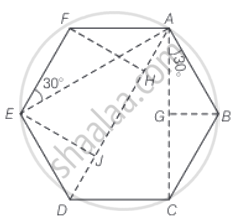
AC = AG + GC = 2AG
= `2l cos 30^circ`
= `2l sqrt(3)/2`
= `sqrt(3)l`
= AE
AD = AH + HJ + JD
= `l sin 30^circ + l + l sin 30^circ`
= `2l`
Force on mass m at A due to mass m at B is, `f_1 = (Gmm)/l^2` = along AB.
Force on mass m at A due to mass m at C is, `f_2 = (Gm xx m)/(sqrt(3)l)^2 = (Gm^2)/(3l^2)` along AC. ......[∵ AC = `sqrt(2)`l]
Force on mass m at A due to mass m at D is, `f_3 = (Gm xx m)/(2l)^2 = (Gm^2)/(4l^2)` along AD ......[∵ AD = 2l]
Force on mass m at A due to mass m at E is, `f_4 = (Gm xx m)/(sqrt(3)l)^2 = (Gm^2)/(3l^2)` along AE.
Force on mass m at A due to mass m at F is, `f_5 = (Gm xx m)/l^2 = (Gm^2)/l^2`along AF.
Resultant force due to `f_1` and `f_5` is `F_1 = sqrt(f_1^2 + f_5^2 + 2f_1f_5 cos 120^circ) = (Gm^2)/l^2` along AD. ...........[∵ Angle between `f_1` and `f_2` = 120°]
Resultant force due to `f_2` and `f_4` is `F_2 = sqrt(f_2^2 + f_4^2 + 2f_2f_4 cos 60^circ) = (sqrt(3)Gm^2)/(3l^2) = (Gm^2)/(sqrt(3)l^2)`along AD.
So, net force along AD = `F_1 + F_2 + F_3`
= `(Gm^2)/l^2 + (Gm^2)/(sqrt(3)l^2) + (Gm^2)/(4l^2)`
= `(Gm^2)/l^2 (1 + 1/sqrt(3) + 1/4)`
APPEARS IN
संबंधित प्रश्न
How will you ‘weigh the sun’, that is estimate its mass? The mean orbital radius of the earth around the sun is 1.5 × 10⁸ km.
Suppose the gravitational potential due to a small system is k/r2 at a distance r from it. What will be the gravitational field? Can you think of any such system? What happens if there were negative masses?
Consider a planet moving in an elliptical orbit round the sun. The work done on the planet by the gravitational force of the sun
(a) is zero in any small part of the orbit
(b) is zero in some parts of the orbit
(c) is zero in one complete revolution
(d) is zero in no part of the motion.
Four particles of equal masses M move along a circle of radius R under the action of their mutual gravitational attraction. Find the speed of each particle.
Who stated the law of gravitation?
Where will you weigh more: at the centre of the earth or at the surface of the earth?
Where will you weigh more: at the moon's surface or at the earth's surface?
What does a force do in the following case?
You pull the skin of your arm
What does a force do in the following case?
You catch a kicked ball.
State the law of gravitation. Why is it called universal?
Is there a gravitational attraction between you and the book? Explain.
State the universal law of gravitation and derive its mathematical expression.
Choose the wrong option.
If the law of gravitation, instead of being inverse-square law, becomes an inverse-cube law- ______.
- planets will not have elliptic orbits.
- circular orbits of planets is not possible.
- projectile motion of a stone thrown by hand on the surface of the earth will be approximately parabolic.
- there will be no gravitational force inside a spherical shell of uniform density.
Answer the following questions in reference to the figure below:

- Which relation is shown in the figure?
- What will happen if the mass of one of the objects is doubled?
Four identical particles of equal masses 1 kg made to move along the circumference of a circle of radius 1 m under the action of their own mutual gravitational attraction. The speed of each particle will be ______.
Two particles of equal mass 'm' go around a circle of radius R under the action of their mutual gravitational attraction. The speed of each particle with respect to its centre of mass is ______.
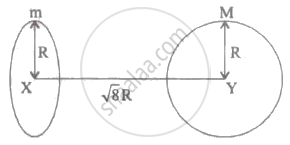
Find the gravitational force of attraction between the ring and sphere as shown in the diagram, where the plane of the ring is perpendicular to the line joining the centres. If `sqrt8` R is the distance between the centres of a ring (of mass 'm')and a sphere (mass 'M') where both have equal radius 'R'.
Ocean tides on Earth are mainly caused by ______.
For an object outside a uniform solid sphere, from where is the sphere's mass considered to act?
