Advertisements
Advertisements
प्रश्न
At noon, the sun and the earth pull the objects on the earth's surface in opposite directions. At midnight, the sun and the earth pull these objects in same direction. Is the weight of an object, as measured by a spring balance on the earth's surface, more at midnight as compared to its weight at noon?
Advertisements
उत्तर
No. Due to the revolution of the Earth around the Sun, the gravitational force of the Sun on the Earth system is almost zero. Hence, the body will not experience any force due to the Sun. Therefore, weight of the object will remain the same.
APPEARS IN
संबंधित प्रश्न
How does the force of gravitation between two objects change when the distance between them is reduced to half?
Choose the correct alternative:
Acceleration due to gravity increases/decreases with increasing depth. (assume the earth to be a sphere of uniform density).
State and explain Kepler's laws of planetary motion. Draw diagrams to illustrate these laws.
A person brings a mass of 1 kg from infinity to a point A. Initially the mass was at rest but it moves at a speed of 2 m s −1 as it reaches A. The work done by the person on the mass is −3 J. The potential at A is
Consider a planet moving in an elliptical orbit round the sun. The work done on the planet by the gravitational force of the sun
(a) is zero in any small part of the orbit
(b) is zero in some parts of the orbit
(c) is zero in one complete revolution
(d) is zero in no part of the motion.
Four particles of equal masses M move along a circle of radius R under the action of their mutual gravitational attraction. Find the speed of each particle.
A particle of mass 100 g is kept on the surface of a uniform sphere of mass 10 kg and radius 10 cm. Find the work to be done against the gravitational force between them to take the particle away from the sphere.
The acceleration produced by a force in an object is directly proportional to the applied _________ And inversely proportional to the _________ Of the object.
All objects in the universe attract each other along the line joining their________.
What does a force do in the following case?
You pull the skin of your arm
What does a force do in the following case?
You twist a piece of rubber.
What do you mean by a gravitational constant?
The gravitational force between two bodies is directly proportional to the product of the masses of those bodies and is ______ of the distance between them.
Mahendra and Virat are sitting at a distance of 1m from each other. Their masses are 75 kg and 80 kg respectively. What is the gravitational force between them? (G = 6.67 × 10⁻¹¹ Nm2/kg2)
State the universal law of gravitation and derive its mathematical expression.
Particles of masses 2M, m and M are respectively at points A, B and C with AB = ½ (BC). m is much-much smaller than M and at time t = 0, they are all at rest (Figure). At subsequent times before any collision takes place ______.

Six point masses of mass m each are at the vertices of a regular hexagon of side l. Calculate the force on any of the masses.
Answer the following questions in reference to the figure below:

- Which relation is shown in the figure?
- What will happen if the mass of one of the objects is doubled?
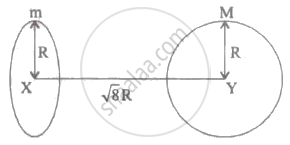
Find the gravitational force of attraction between the ring and sphere as shown in the diagram, where the plane of the ring is perpendicular to the line joining the centres. If `sqrt8` R is the distance between the centres of a ring (of mass 'm')and a sphere (mass 'M') where both have equal radius 'R'.