Advertisements
Advertisements
प्रश्न
A particle of mass 100 g is kept on the surface of a uniform sphere of mass 10 kg and radius 10 cm. Find the work to be done against the gravitational force between them to take the particle away from the sphere.
Advertisements
उत्तर
The work done against the gravitational force to take the particle away from the sphere to infinity is equal to the difference between the potential energy of the particle at infinity and potential energy of the particle at the surface of the sphere.
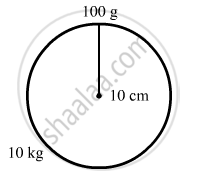
\[\therefore W = 0 - \left( - \frac{G \times 10 \times 0 . 1}{1 \times 0 . 1} \right)\]
\[ = \frac{6 . 67 \times {10}^{- 11} \times 1}{1 \times 0 . 1}\]
\[ = 6 . 67 \times {10}^{- 10} J\]
APPEARS IN
संबंधित प्रश्न
What is the magnitude of the gravitational force between the earth and a 1 kg object on its surface? (Mass of the earth is 6 × 1024 kg and radius of the earth is 6.4 × 10⁶ m).
Choose the correct alternative:
Acceleration due to gravity increases/decreases with increasing depth. (assume the earth to be a sphere of uniform density).
A person sitting in a chair in a satellite feels weightless because
A semicircular wire has a length L and mass M. A particle of mass m is placed at the centre of the circle. Find the gravitational attraction on the particle due to the wire.
Two concentric spherical shells have masses M1, M2 and radii R1, R2 (R1 < R2). What is the force exerted by this system on a particle of mass m1 if it is placed at a distance (R1+ R2)/2 from the centre?
Explain the following:
People often shake the branches of a tree for getting down its fruits.
How will the force of gravitation between two objects change if the distance between them is:
Doubled
Is the law of gravitation applicable in case of the sun and the moon?
Gravity is another kind of ________. It exerts all through the ________. The Sun's gravity keeps the ___________ in their orbits. Gravity can only be felt with very large ________.
State Newton's law of gravitation. What is the difference between:
Gravity and gravitation
The distance-time values for an object moving along straight line are given below:
| Time (s) | Distance (m) |
| 0 | 0 |
| 1 | 1 |
| 2 | 8 |
| 3 | 27 |
Answer the following question.
State Newton’s law of gravitation and express it in vector form.
What do you mean by a gravitational constant?
The ______ force is much weaker than other forces in nature.
To project the rockets which of the following principle(s) is /(are) required?
Particles of masses 2M, m and M are respectively at points A, B and C with AB = ½ (BC). m is much-much smaller than M and at time t = 0, they are all at rest (Figure). At subsequent times before any collision takes place ______.

Shown are several curves (Figure). Explain with reason, which ones amongst them can be possible trajectories traced by a projectile (neglect air friction).
Give scientific reasons for the following:
Newton's gravitational law is the universal law of gravitation.
A hollow spherical shell of uniform density exerts what gravitational force on a point mass placed inside it?
