Advertisements
Advertisements
Question
A particle of mass 100 g is kept on the surface of a uniform sphere of mass 10 kg and radius 10 cm. Find the work to be done against the gravitational force between them to take the particle away from the sphere.
Advertisements
Solution
The work done against the gravitational force to take the particle away from the sphere to infinity is equal to the difference between the potential energy of the particle at infinity and potential energy of the particle at the surface of the sphere.
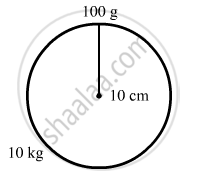
\[\therefore W = 0 - \left( - \frac{G \times 10 \times 0 . 1}{1 \times 0 . 1} \right)\]
\[ = \frac{6 . 67 \times {10}^{- 11} \times 1}{1 \times 0 . 1}\]
\[ = 6 . 67 \times {10}^{- 10} J\]
APPEARS IN
RELATED QUESTIONS
How does the force of gravitation between two objects change when the distance between them is reduced to half?
What is the magnitude of the gravitational force between the earth and a 1 kg object on its surface? (Mass of the earth is 6 × 1024 kg and radius of the earth is 6.4 × 10⁶ m).
If you compare the gravitational force on the Earth due to the Sun to that due to the Moon, you would find that the Sun’s pull is greater than the Moon’s pull. (You can check this yourself using the data available in the succeeding exercises). However, the tidal effect of the Moon’s pull is greater than the tidal effect of Sun. Why?
Choose the correct alternative:
Acceleration due to gravity is independent of mass of the earth/mass of the body.
State two applications of universal law of gravitation.
Two spherical balls of mass 10 kg each are placed 10 cm apart. Find the gravitational force of attraction between them.
Two small bodies of masses 10 kg and 20 kg are kept a distance 1.0 m apart and released. Assuming that only mutual gravitational forces are acting, find the speeds of the particles when the separation decreases to 0.5 m.
A semicircular wire has a length L and mass M. A particle of mass m is placed at the centre of the circle. Find the gravitational attraction on the particle due to the wire.
Explain the following:
People often shake the branches of a tree for getting down its fruits.
Why don't you feel the force of attraction between your friend sitting close to you and yourself?
A ball is thrown up with a speed of 4.9 ms-1.
Calculate the time it takes to reach this height.
State the law of gravitation. Why is it called universal?
Is there a gravitational attraction between you and the book? Explain.
The value of universal gravitational constant (G) in the SI unit is ______.
To project the rockets which of the following principle(s) is /(are) required?
State the universal law of gravitation and derive its mathematical expression.
For the weight of body of mass 5 kg to be zero on equator of the earth, angular velocity of the earth must be (The radius of earth = 6400 km, acceleration due to gravity = 10 m/s2).
Law of gravitation gives the gravitational force between
How is the gravitational force between two point masses affected when they are dipped in water keeping the separation between them the same?
The gravitational force between a hollow spherical shell (of radius R and uniform density) and a point mass is F. Show the nature of F vs r graph where r is the distance of the point from the centre of the hollow spherical shell of uniform density.
