Advertisements
Advertisements
Question
A tunnel is dug along a chord of the earth at a perpendicular distance R/2 from the earth's centre. The wall of the tunnel may be assumed to be frictionless. Find the force exerted by the wall on a particle of mass m when it is at a distance x from the centre of the tunnel.
Advertisements
Solution
Let d be distance of the particle from the centre of the Earth.
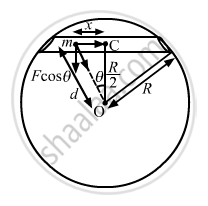
\[\text { Now }, d^2 = x^2 + \left( \frac{R^2}{4} \right) = \frac{4 x^2 + R^2}{4}\]
\[ \Rightarrow d = \left( \frac{1}{2} \right)\sqrt{4 x^2 + R^2}\]
Let M be the mass of the Earth and M' be the mass of the sphere of radius d.
Then we have :
\[M = \left( \frac{4}{3} \right)\pi R^3 \rho\]
\[ M^1 = \left( \frac{4}{3} \right)\pi d^3 \rho\]
\[ \therefore \frac{M^1}{M} = \frac{d^3}{R^3}\]
Gravitational force on the particle of mass m is given by
\[F = \frac{G M^1 m}{d^2}\]
\[ \Rightarrow F = \frac{G d^3 Mm}{R^3 d^2}\]
\[ \Rightarrow F = \frac{GMm}{R^3}d\]
∴ Normal force exerted by the wall, FN = F cos θ
\[= \frac{GMmd}{R^3} \times \frac{R}{2d} = \frac{GMm}{2 R^2}\]
APPEARS IN
RELATED QUESTIONS
State Kepler’s law which is represented by the relation r3 ∝ T2.
Write the three laws given by Kepler. How did they help Newton to arrive at the inverse square law of gravity?
A body is suspended from a spring balance kept in a satellite. The reading of the balance is W1 when the satellite goes in an orbit of radius R and is W2 when it goes in an orbit of radius 2 −R.
Which of the following quantities remain constant in a planetary motion (consider elliptical orbits) as seen from the sun?
A semicircular wire has a length L and mass M. A particle of mass m is placed at the centre of the circle. Find the gravitational attraction on the particle due to the wire.
Derive an expression for the gravitational field due to a uniform rod of length L and mass M at a point on its perpendicular bisector at a distance d from the centre.
A particle of mass 100 g is kept on the surface of a uniform sphere of mass 10 kg and radius 10 cm. Find the work to be done against the gravitational force between them to take the particle away from the sphere.
Define one Newton. How much maximum acceleration can it produce in a mass of 1 kg?
Distinguish between gravity and gravitation
How will the force of gravitation between two objects change if the distance between them is:
Halved
How will the force of gravitation between two objects change if the distance between them is:
Made four times
Is the law of gravitation applicable in case of the sun and the moon?
A ball is thrown up with a speed of 4.9 ms-1.
Prove that the time of ascent is equal to the time of descent.
At what height above the earth's surface would the value of acceleration due to gravity be half of what it is on the surface? Take the radius of earth to be R.
Is there a gravitational attraction between you and the book? Explain.
Answer the following question.
State Newton’s law of gravitation and express it in vector form.
Molecules in air in the atmosphere are attracted by gravitational force of the earth. Explain why all of them do not fall into the earth just like an apple falling from a tree.
We can shield a charge from electric fields by putting it inside a hollow conductor. Can we shield a body from the gravitational influence of nearby matter by putting it inside a hollow sphere or by some other means?
If three equal masses m are placed at the three vertices of an equilateral triangle of side 1/m then what force acts on a particle of mass 2m placed at the centroid?
